How to Reduce PR Review Time (Without Rubber Stamps)
FASTER, NOT SHALLOWER
Faster review that isn't shallower review: smaller PRs, spread load, pickup-time pressure. What actually shortens review time without approval theater.
TL;DR: Most "slow review" is a PR sitting in a queue, not a reviewer reading slowly. Fix it in this order: shrink your PRs (the research says 200-400 lines max), attack pickup time, spread the review load past one overworked senior, and move nitpicks to a linter. Rubber-stamping is not on the list: approvals that take 40 seconds aren't reviews, they're theater.
Your team says reviews are slow. Your cycle time agrees. And the reflex fix - "everyone please review faster" - is how you trade a speed problem for a quality problem. The 2023 DORA report found that teams with faster code reviews show 50% higher software delivery performance, so the prize is real. The trick is getting there without turning approval into a formality.
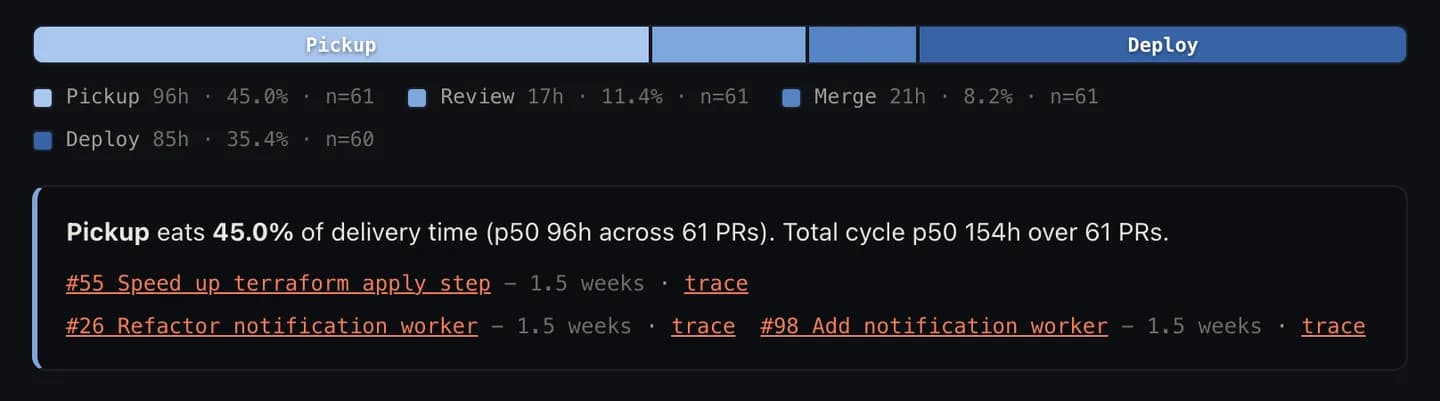
Where does PR review time actually go?
Mostly nowhere. In Google's study of 9 million reviewed changes, the overall median for the entire review process is under 4 hours, and small changes get initial feedback in under an hour. If your PRs take three days, the difference between you and that number is not reading speed. It's a diff sitting untouched while its author context-switches to something else.
That's the honest diagnosis, and it's good news: waiting is the cheapest thing in your process to remove. Nobody has to review harder. The queue just has to move.
Split "review time" into its real stages before you fix anything:
- Pickup - ready-for-review until the first reviewer action. This is where days vanish. It gets its own article, because it's the highest-leverage number in the whole review pipeline.
- Review - the actual back-and-forth of comments and revisions.
- Merge - approved but not merged, usually waiting on CI or on courage.
If you only track the total, you'll prescribe the wrong medicine. A team with a pickup problem doesn't need faster readers; it needs someone to start.
The research on PR size
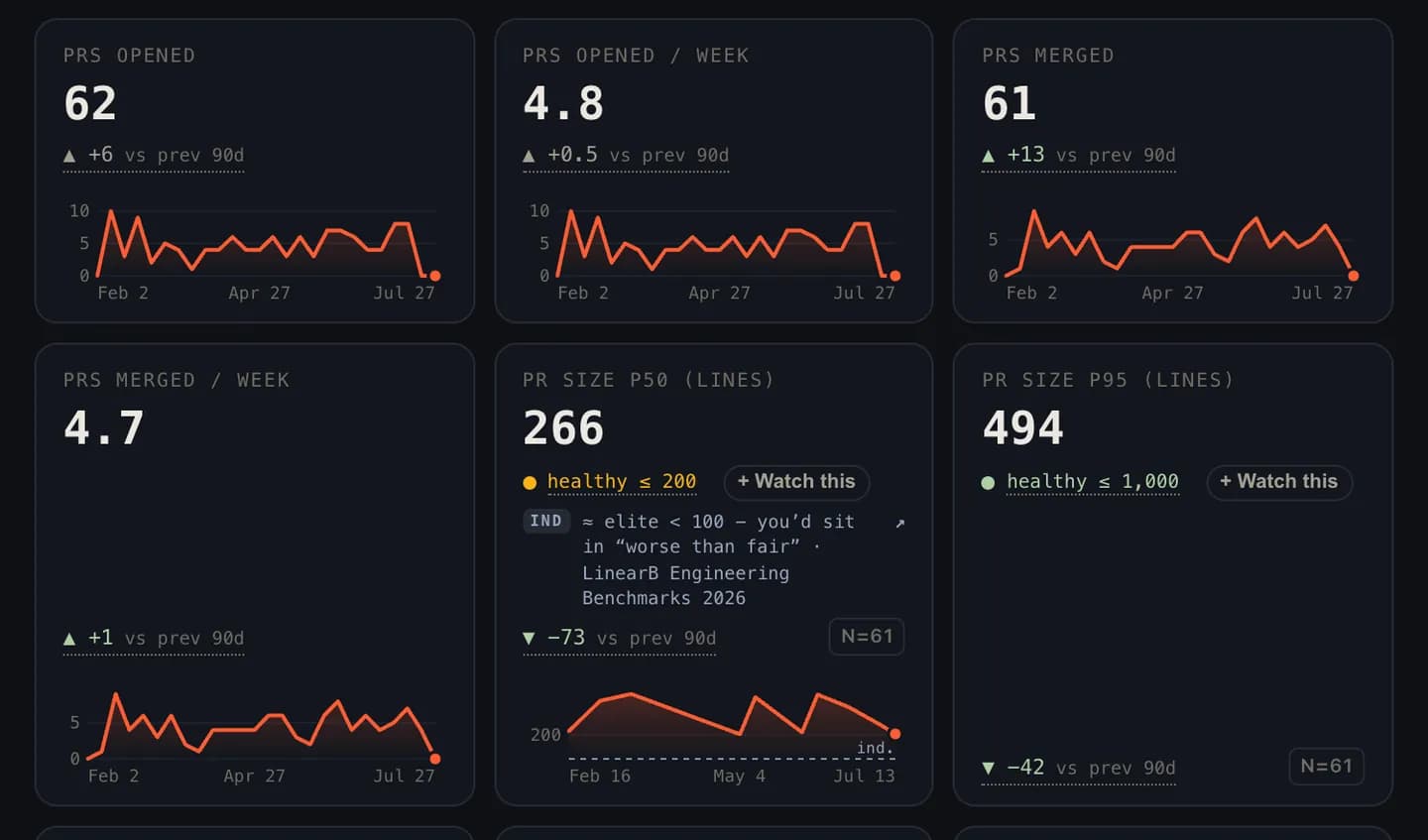
The most-cited numbers in code review come from SmartBear's study of a Cisco Systems team: roughly 2,500 reviews across 3.2 million lines of code. The findings: reviewers should handle no more than 200-400 lines at a time; a review of that size over 60-90 minutes yields 70-90% defect discovery; and defect density drops significantly when reviewers move faster than 500 lines per hour.
Read that last one again. Past a certain speed, a reviewer isn't reviewing anymore - they're scrolling. A 1,200-line PR doesn't get a slower, more careful review. It gets a skim and an "LGTM," because no human holds 1,200 lines in their head. Big PRs are slow and badly reviewed. You pay twice.
LinearB's 2026 benchmarks (8.1 million+ PRs across 4,800 teams) point the same direction: elite teams keep PRs under 100 changed lines. Small is the operating condition under which review works at all.
How do you reduce review time without losing depth?
Ranked by leverage, cheapest first:
- Shrink the PRs. One logical change per PR. Split the refactor from the feature, the rename from the logic. A stack of three 150-line PRs merges faster than one 450-line PR, and each gets a real read.
- Attack pickup time. Set a working agreement: first response within a few working hours, and make the waiting queue visible so nobody has to nag. This is a habit change, not a process overhaul.
- Spread the load. If one senior does most of the reviewing, your review speed is capped by one person's calendar, and you've built a bottleneck, a burnout risk, and a bus-factor problem into the same seat. Rotate reviewers deliberately, and let the next tier review with the senior as backstop.
- Move nitpicks to a linter. Every style debate in a review thread is friction wearing a quality costume. Automate formatting, import order, and naming conventions, and let humans argue about the things machines can't check: design, correctness, blast radius.
- Name one reviewer. Google's median change has exactly one approver. A request aimed at a person gets picked up; a request aimed at a team gets admired.
What doesn't work
Rubber stamps. Approval-in-40-seconds makes the dashboard green and the codebase worse. If your review time improved because reviews stopped happening, you didn't fix anything. You disconnected the smoke alarm.
More reviewers per PR. "More eyes" reliably means nobody really looks. Responsibility divided by three is zero.
Public shaming. Reading out stuck PRs in standup produces resentment and quiet workarounds, not speed. A PR that's been stuck for a week is a system signal (blocked, abandoned, or too big to face), and each of those has a different fix. Diagnose it; don't perform it.
Fixing review in isolation. DORA's own caveat: fast reviews don't lift delivery performance if the constraint lives elsewhere - a flaky CI pipeline or a release train that leaves monthly will happily eat every hour you save. Find the actual bottleneck first; review is often it, but "often" isn't "always". This is exactly what a review-friction breakdown is for: seeing whether your days go to pickup, depth, load, or size before you spend a quarter fixing the wrong one.
The door out of slow reviews isn't heroic reviewing. It's small diffs, a moving queue, and more than one person who can say yes. That's the lead-and-system side of the problem; if you're the author on the other end of the queue, the author's-edition companion covers the half you actually control.
Frequently asked
How long should a PR review take?
LinearB's 2026 benchmarks, drawn from 8.1 million+ pull requests, put elite review time under 3 hours and 'needs focus' at over 24. Google's internal median for the entire review process is under 4 hours. If your PRs routinely take days, the gap is almost always waiting, not reviewing.
Do more reviewers make review faster?
Usually the opposite. Google's study of 9 million reviewed changes found the median change has exactly one approver. Adding reviewers diffuses responsibility: when three people are asked, each assumes another will start. One clearly named reviewer beats a CC list.
Does reducing review time hurt code quality?
Not if you cut the waiting instead of the reading. Pickup time and queue time are pure delay; removing them costs nothing. Quality only suffers when you compress the actual reading, which is why SmartBear's research flags review rates faster than 500 lines per hour.
What's the single fastest way to speed up reviews?
Shrink the PR. The SmartBear study at Cisco found reviewers are effective on 200-400 lines at a time; beyond that, defect discovery drops. Small PRs get picked up sooner, read properly, and merged the same day. Everything else is second-order.