Busfactor vs DX in 2026: Repo Receipts or Survey Science?
REPO RECEIPTS OR SURVEY
Hover or focus to flip ↻An honest DX alternative comparison: their survey science and benchmark cohort conceded, what a Likert composite can't prove, and who should pick which tool.
TL;DR: DX wrote the measurement science this category runs on - the Core 4, the DXI, a benchmark base of 800+ organizations - and after a roughly $1B Atlassian acquisition it has distribution nobody can match. If you want the industry-standard developer-experience survey program, buy it; we won't pretend our survey module competes with theirs. The honest case for Busfactor as a DX alternative is architectural: their flagship number is an averaged feeling with an unpublished money coefficient attached, and ours is a quoted row from your own repo that re-runs byte-identically. Which core you want under the product is the actual decision, and this page lays both out with citations.
There's a genuine philosophical fork in engineering intelligence, and DX versus Busfactor is its cleanest expression: measure how developers feel about the system with world-class survey science, or measure what the system did with recomputable telemetry. Both are legitimate. Only one of them can be handed to an auditor. Concessions first, as always. Everything below is a snapshot of both products as of July 2026; this category moves fast enough that a dated comparison is the only honest kind. (For the framework-agnostic version of this decision, start with the buyer's guide.)
What DX genuinely does better
They own the standard. The DX Core 4 (Speed, Effectiveness, Quality, Impact, each with a key metric and counterbalancing secondaries) comes from the researchers behind the DORA and SPACE lineage and has become procurement vocabulary. Even rival vendors ship support for rolling it out (Swarmia's Core 4 page is a competitor implementing a competitor's framework - that's what owning the standard looks like).
The benchmark cohort. The DXI is benchmarked against "over four million data samples from more than 800 organizations" and 40,000+ developers. Busfactor's survey module has no benchmark cohort at all, and we're not going to pretend a v1 instrument matches a research program. It doesn't.
Methodological triangulation. Core 4 collection explicitly layers three methods to cross-validate: system metrics, self-reported surveys, and in-the-moment experience sampling. As survey science, that's the real thing, done carefully.
Their own honesty. This deserves singling out: DX's AI Measurement Hub states that actual AI productivity gains run "5-15%, rather than 50-100%," warns that acceptance rate is a flawed measure because accepted code is often heavily modified or deleted before commit, and their Core 4 paper cautions against setting targets on speed metrics. When a vendor's research team undercuts AI hype with their own data, quote them - we do, approvingly.
And then there's distribution. Atlassian acquired DX for approximately $1B; the reach into every Jira-running org on earth follows. No small vendor competes with that, and we won't claim to.
What a Likert composite can't prove
Here's the fork, stated precisely from their own material.
The flagship number is a survey. The DXI is "a composite score derived from 14 standardized Likert-scale survey items," computed as a mean of driver sentiment scores. The full canonical list of all 14 drivers isn't published on one public page; the site defers to a gated whitepaper. The number your board sees is an average of feelings, benchmarked against other orgs' averages of feelings.
The money coefficient arrives without its derivation. "A single-point increase in the DXI score translates to saving 13 minutes per week per developer." The regression behind that sentence is not published anywhere we could find. It may be excellent work. You cannot check it, and neither can your CFO.
Half the standard is perception. Core 4's key metrics include the DXI itself, Perceived Rate of Delivery, and perceived software quality. Self-report is hard-wired into the framework, by design. The trouble is that developer perception of productivity can be wrong in sign, as the randomized-trial evidence covered in the AI productivity paradox shows. A framework whose flagship inputs are perceptions inherits that failure mode structurally.
And when the number moves, the drill-down is sentiment by driver rather than the commits, PRs, and queues a leader can act on Monday. (How the whole category scores on recomputability is in the determinism audit.)
Where we stand on surveys - the concession inside the attack. Busfactor ships a survey module too (DevEx surveys): org-defined Likert items, structural anonymity, the N and response rate disclosed on every readout, deterministic aggregation. On instrument science and benchmark depth, DX is ahead of it, full stop. The architectural difference is placement. Our surveys are context alongside the telemetry, never the flagship: no self-report sits inside any judged metric, any money number, or any grade. Theirs is the flagship. That's the whole fork.
Pricing and motion
DX's pricing page publishes no figures: modular pricing "based on the insights and optimization tools your company needs," developer-license based, usage tiers for MCP access, contracts from a one-year term, free proof-of-concept for a subset of the org. Sales-led, annual, enterprise. Busfactor is self-serve with published per-developer tiers by org size on the pricing page: connect read-only, findings the same day. These are different motions for different buyers more than competing quotes; if your org wants the procurement-managed enterprise program, that's their motion and it works.
What Busfactor does that DX doesn't
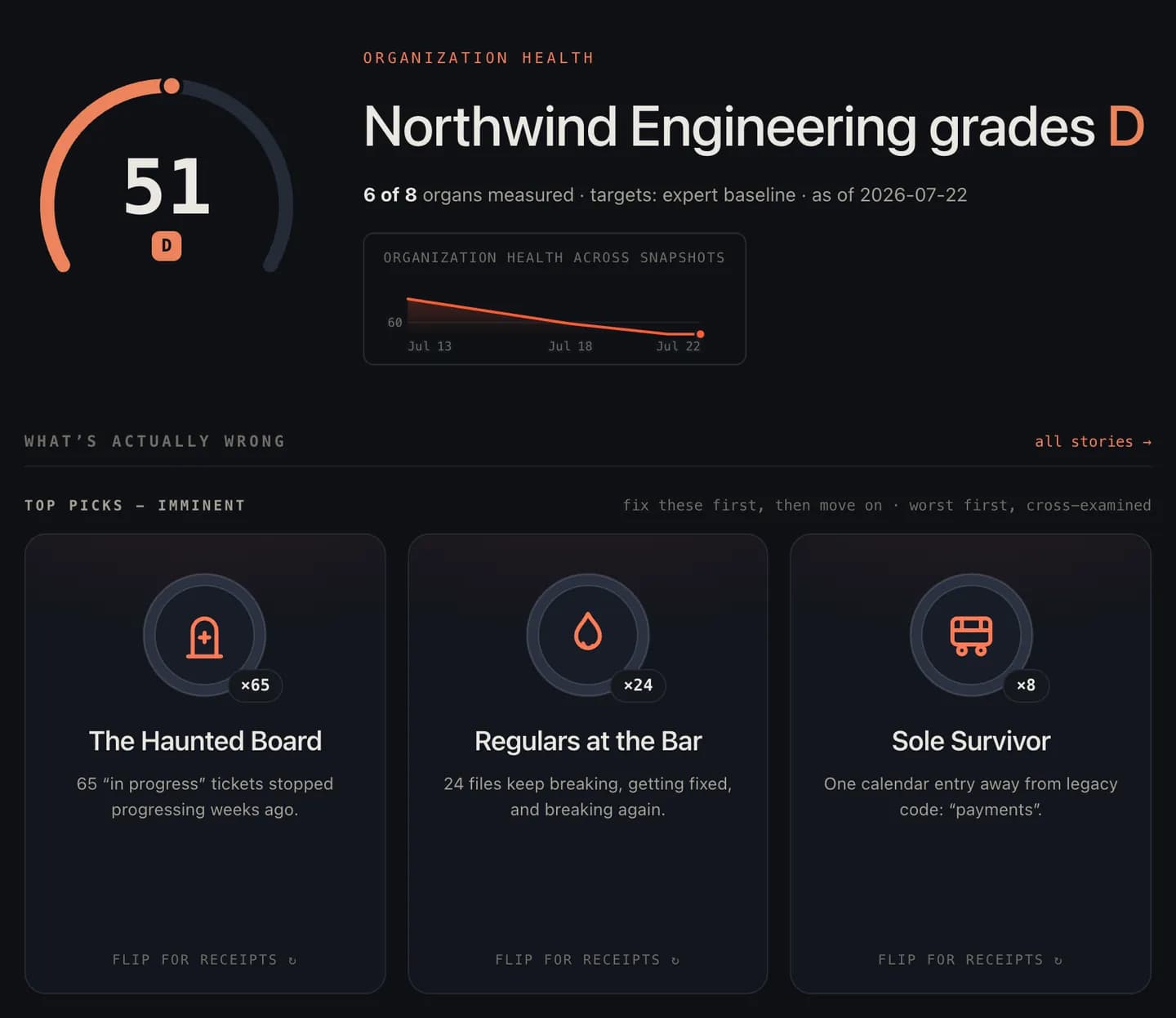
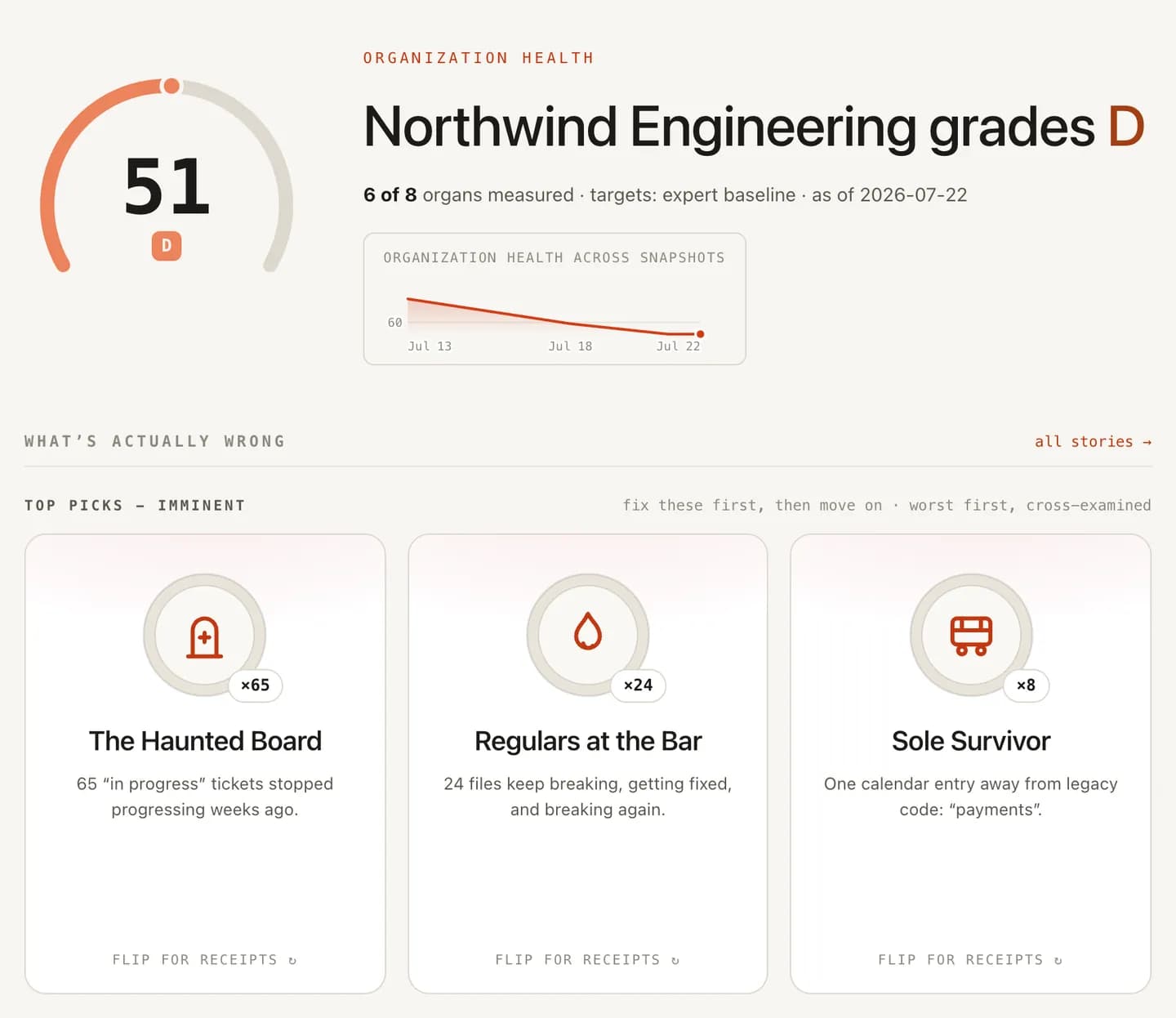
- An actual grade. DX measures and benchmarks; it doesn't judge. Busfactor's assessment grades ~47 stats against published bands and issues a quarterly report card with the receipts (actual PRs, commits, tickets) linked on every claim.
- Priced consequences. Drains in your currency, payback estimates on every prescription, on the money surfaces. The DXI's 13-minute coefficient prices their metric; our money numbers trace to your rows.
- Recomputable everything. Zero LLM in the metric path, byte-identical reruns, provenance printed on exports. A survey answer, however scientifically collected, cannot be re-derived from system data. No fault of DX's execution; that is simply what the instrument is.
- On people posture, credit where due: DX measures AI agents as team extensions rather than ranked contributors and warns against individual speed targets. Busfactor goes further - no per-person composite exists on any surface, and scorecards frame people by strengths and the cost of losing them.
Choosing a DX alternative in 2026: who should pick which
| You are… | Pick |
|---|---|
| Rolling out the industry-standard DevEx survey program org-wide | DX |
| On the Atlassian estate and heading deeper into it | DX |
| Sold on benchmarked sentiment percentiles across 800+ orgs | DX |
| Need every number recomputable - by an auditor, a CFO, or a skeptical staff engineer | Busfactor |
| Want a diagnosis with priced fixes, not a measurement program to staff | Busfactor |
| A smaller org that wants findings this week, not a one-year contract | Busfactor |
Run the evaluation questions against both, then add one specific to this matchup: when this number moves, what exactly will you show me? One of us answers with driver sentiment. The other answers with rows.
Frequently asked
What is the DX Developer Experience Index (DXI)?
DX's flagship metric: a composite score derived from 14 standardized Likert-scale survey items, computed as a mean of driver sentiment scores and benchmarked against their research dataset of 800+ organizations and 40,000+ developers. DX states that a one-point DXI increase translates to saving 13 minutes per developer per week, a coefficient from their internal regression work whose derivation is not published. It's the most mature survey instrument in the category; it is also, by construction, an averaged feeling rather than a recomputable measurement.
How much does DX cost?
DX publishes no prices. Their pricing page describes modular pricing based on the insights and tools your company needs, licensing based on developer seats, usage tiers for MCP server access, contracts starting at a one-year term, and a free proof-of-concept for a subset of the org. Post-acquisition Atlassian bundling isn't reflected on the page as of July 2026. Busfactor publishes per-developer tiers, self-serve. The honest comparison is a quote you negotiate versus a price you can read.
Is the DX Core 4 framework worth adopting?
As shared vocabulary, yes: it's the closest thing the category has to a standard, and even rival vendors ship support for rolling it out. Go in with open eyes about its construction: half of its key numbers are perceptions (the DXI itself, perceived rate of delivery, perceived software quality), collection explicitly mixes system metrics with self-report and experience sampling, and DX's own guidance warns against setting targets on the speed metric. You can adopt the framework's vocabulary and still demand that the telemetry half of it be recomputable. That's precisely the standard Busfactor holds itself to.
Receipts
- DX - Guide to the Developer Experience Index (DXI)
- DX - Introducing DXI (composite computation)
- DX - Measuring developer productivity with the DX Core 4 (research paper)
- DX - Core 4 announcement (PR Newswire)
- DX - AI Measurement Hub
- DX - Pricing page (as of July 2026)
- TechCrunch - Atlassian acquires DX for ~$1B (September 2025)