Busfactor vs Faros AI in 2026: Data Lake or Diagnosis?
DATA LAKE OR DIAGNOSIS
Hover or focus to flip ↻A cited Faros AI alternative comparison: their connector breadth and enterprise scale conceded, the GenAI insight layer questioned, and who should buy which.
TL;DR: Faros AI is the enterprise data platform of this category: 100+ tools unified into one canonical schema, on-prem deployment, real cohort methodology, and the research report that happens to be the best public evidence for our own thesis. If you run many hundreds of engineers across thirty tools, they're a credible buy and we won't contest that deal. The honest case for Busfactor as a Faros AI alternative: their insight layer is explicitly ML and GenAI - a narrator that can misstate the numbers beneath it - while ours is deterministic, graded, and priced, self-serve, below their deal floor. Citations throughout, including the ones that flatter them.
Faros and Busfactor barely compete for the same purchase order, which is what makes this comparison worth writing honestly: the interesting question isn't "who wins," it's "which problem do you actually have?" A data-unification problem and a diagnosis problem look similar on a slide and are entirely different purchases. Everything below is a mid-2026 snapshot of two fast-moving products, dated as of July 2026. (Category-wide framework: the buyer's guide.)
What Faros genuinely does better
Connector breadth and the canonical schema. The platform ingests via cloud connectors, source/events CLIs, and webhooks (with "any-source compatibility" for homegrown systems) into a unified data model, and their impact analysis draws on "data from over 100 tools." Cross-tool entity resolution at enterprise scale is their moat and a different weight class from Busfactor's GitHub-first connector set. No contest on this row.
Real evaluation methodology. Their Copilot module measures AI impact with A/B and before/after cohort comparisons, seniority segmentation, and baseline-then-lift analysis, plus token-spend intelligence connecting AI cost to outcomes. That's a more elaborate experimental apparatus than our per-tool cohort tables, and enterprise buyers who want the full study get it here.
On enterprise posture: SaaS, hybrid, or on-prem deployment and a security ladder up to RBAC per their pricing page. Busfactor offers none of that today.
The research. The Acceleration Whiplash report (22,000 developers, 4,000 teams, two years of telemetry) is, in our view, the most important public dataset in the field right now. More on it below, because it deserves its own section rather than a bullet.
They act as well as measure. Clara feeds coding agents context derived from past PRs and tickets, expands thin tickets into specs, and delivers agent-authored PRs with human-in-the-loop guardrails. Whatever we think of LLMs in the production loop, it's shipped, and it's a capability we deliberately don't build.
The GenAI narrator problem
The disagreement starts at the insight layer. Faros's data layer is telemetry-first; their own research pointedly brands itself as "not self-reported surveys," which is our ethos too. But the insight layer, Lighthouse AI, explicitly runs on "statistical analysis, machine learning, and GenAI": GenAI summaries of any dashboard, natural-language query helpers, ML-generated recommendations. That places a language model between the numbers and the human reading them - the exact seam where a figure can be misstated, smoothed, or invented, and where no re-run can prove what the narrator said last quarter. Two adjacent disclosure gaps compound it: how "% of AI-generated code" is computed is not stated on the public page, and nothing in their material claims reproducibility of any number.
Busfactor's bet is the opposite: no model anywhere in the metric path, verdicts rendered by deterministic rules against published bands, receipts linked on every claim, and exports that print run id, engine version, ruleset version, and content hash so "re-run it and diff the bytes" is a test you can actually perform. The category-wide version of this audit, naming who has models inside load-bearing numbers with citations, is in the determinism audit.
Their research is our best receipt
We owe Faros a public thank-you, because the Whiplash report documents, at scale, the exact failure mode Busfactor was built to catch. At high AI adoption, across 22,000 developers: PR size +51%, epics completed +66.2%, task throughput +33.7% - and code churn +861%, bugs per PR +28%, bugs per developer +54%, monthly incidents +57.9%, median review time 5x higher, deployments per week down 11.7%, and 31% more PRs merged without any review. Correlational, as they carefully frame it. Still, it is the sharpest public picture of adoption outrunning absorption: the review safety net thinning precisely when output surges. (What that looks like inside one codebase, and what to do about it, is our is AI making our code worse walkthrough.)
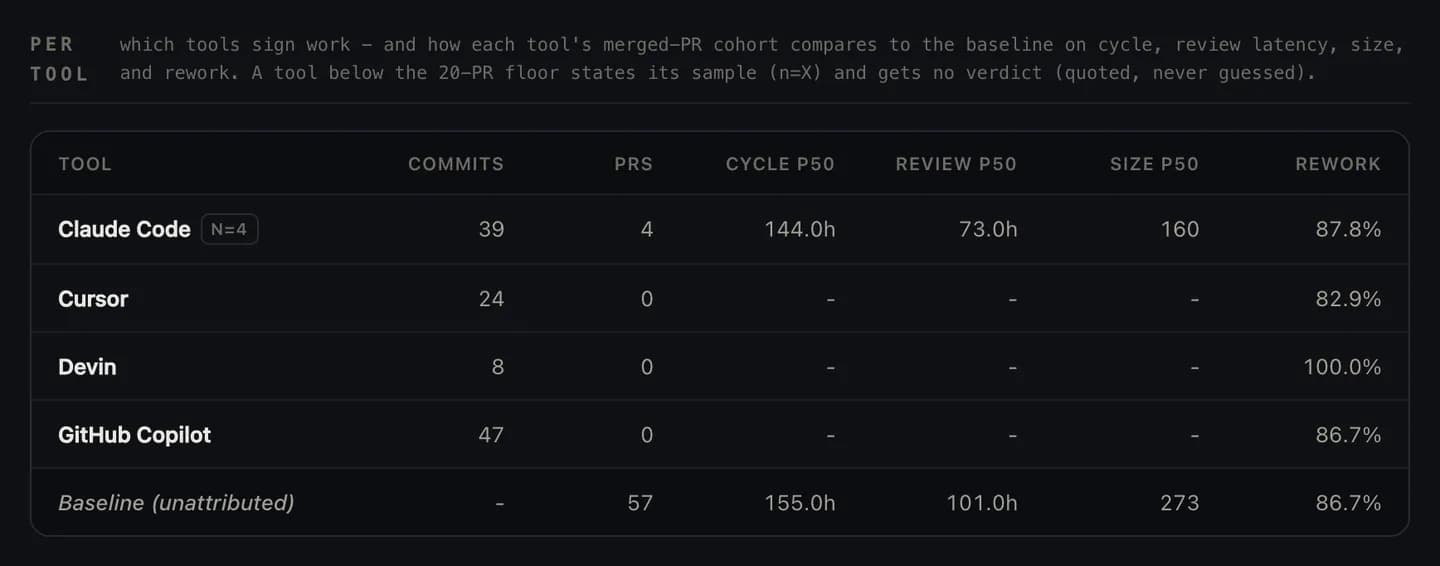
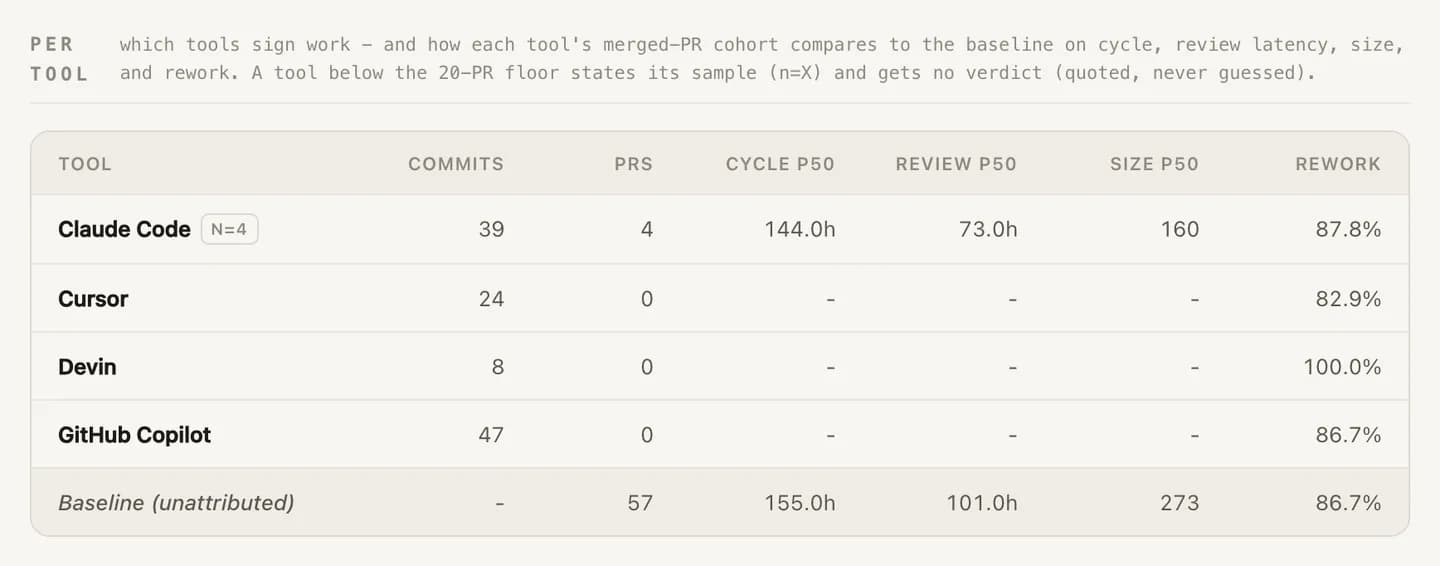
The difference is what each product does with that insight. Faros gives an enterprise the lake to study it; Busfactor gives a CTO the verdict: deterministic per-tool cohorts against your baseline, a rework engine that separates healthy iteration from delivered-then-broken code, an AI-reviewed share with per-bot receipts, and a clean-leverage-or-paying-twice call with the sample size printed on it.
Pricing and motion
Faros is quote-only: three tiers (Professional, Enterprise, Ultimate) differentiated by connector types, schema access, and the security ladder, fees quoted in US dollars, no self-serve motion, no published figures. Busfactor publishes per-developer tiers on the pricing page, self-serve, findings the same day you connect. These are different markets: they cannot profitably serve the 40-developer org that expenses a monthly tier, and we don't compete for the multi-hundred-seat enterprise data-platform contract. If you're reading both quotes side by side, one of you two has misdiagnosed the problem.
What Busfactor does that Faros doesn't
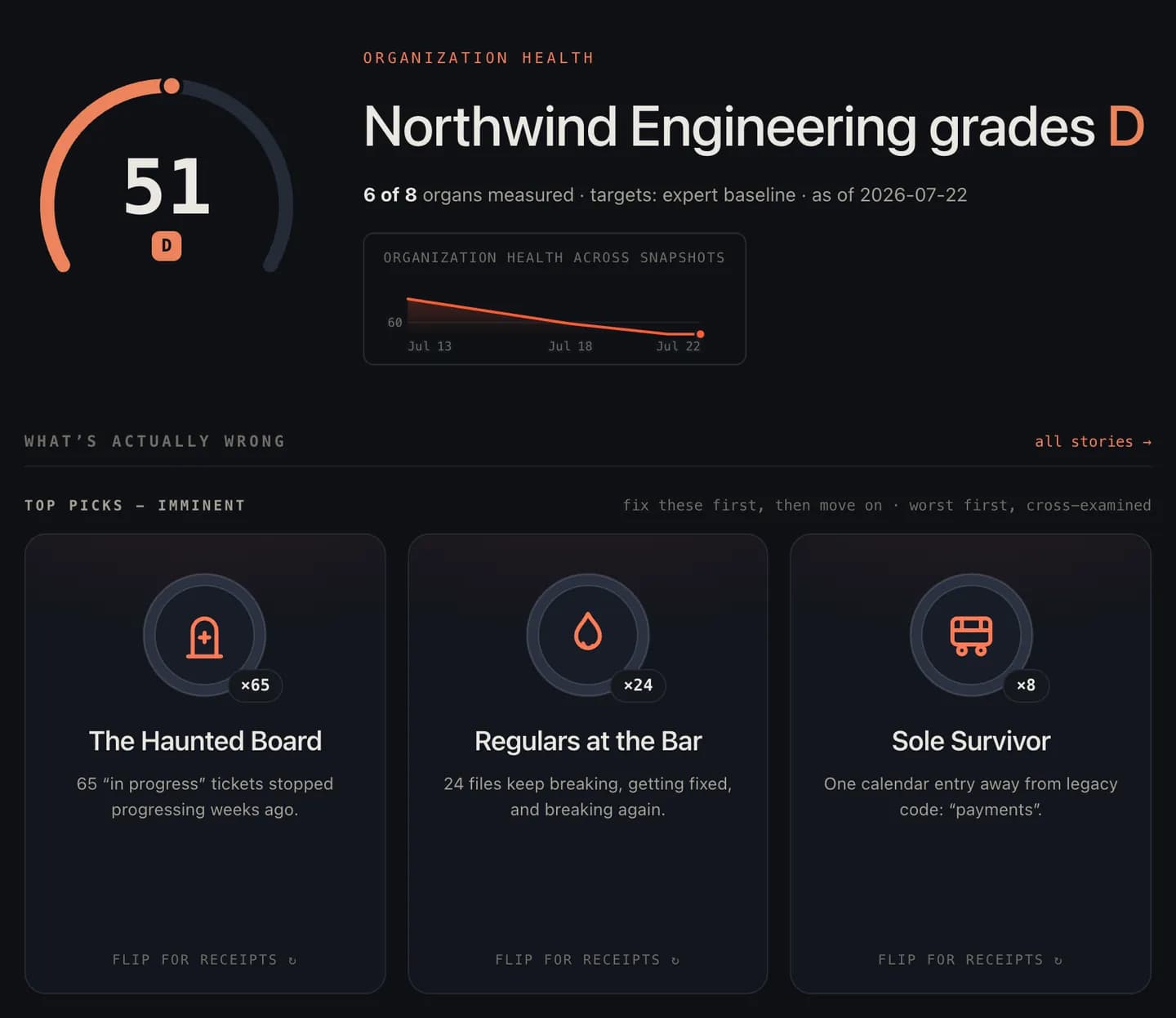
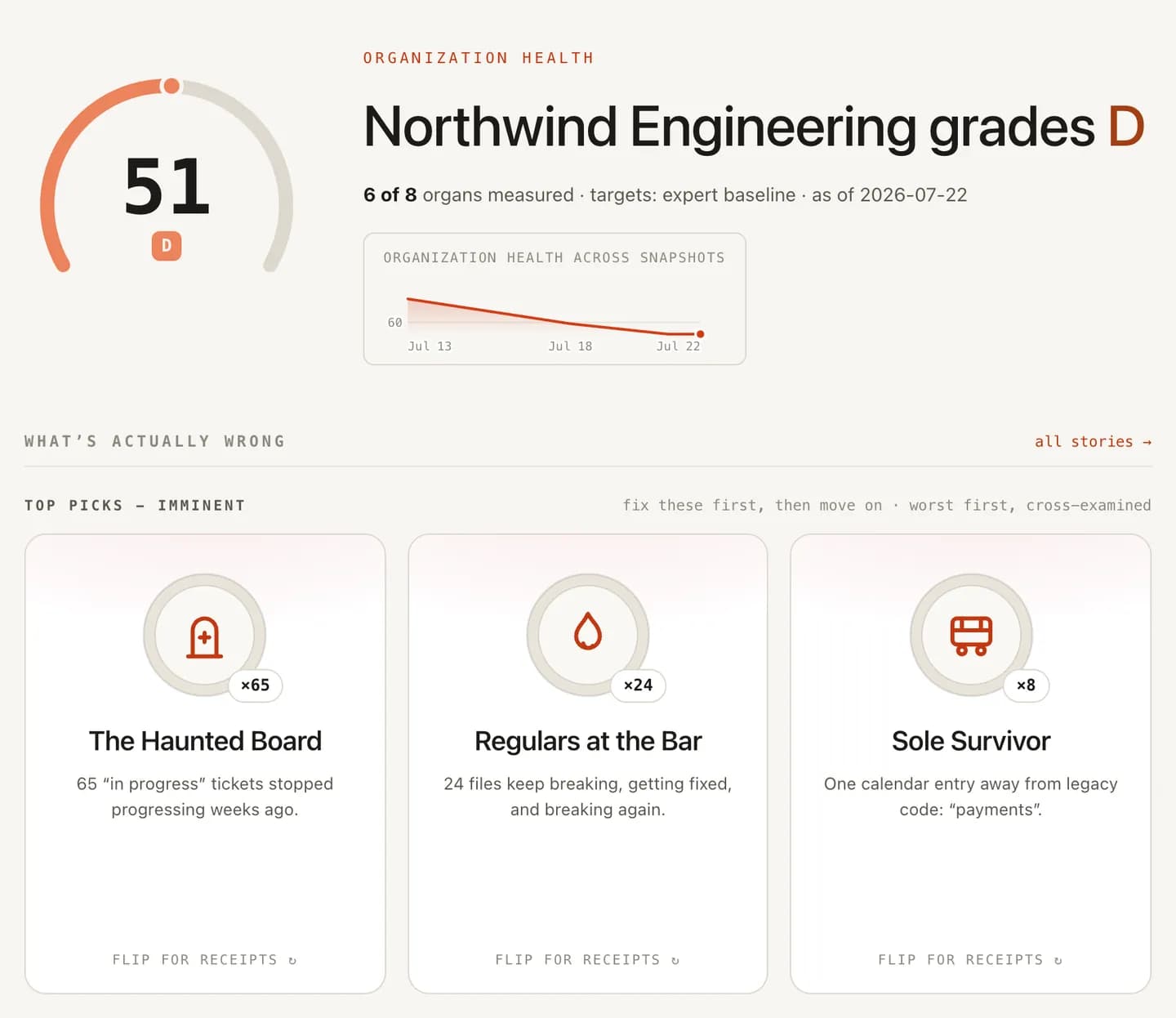
- A grade and a price tag. Nobody at Faros grades your quarter or puts a payback period on a fix. Busfactor's assessment takes a stance: judged stats, a report card, priced drains and fix-ROI on the money surfaces in your currency.
- Quote-only by construction. Their narrator can summarize anything, which means it can misstate anything. Our numbers are quoted from rows or they don't render.
- Person-grain restraint. Their Copilot module markets power-user identification, which is person-grain AI usage analysis. Busfactor refuses person-grain AI cohorts outright; tools, areas, and orgs get cohorts, people never do, and scorecards exist to price losing someone, not to rank them.
- A price a mid-size org can expense, with everything in every tier.
Choosing a Faros AI alternative in 2026: who should pick which
| You are… | Pick |
|---|---|
| 500+ engineers, 30+ tools, and a data-unification problem | Faros |
| Procurement requires on-prem or hybrid deployment today | Faros |
| Want the full A/B research apparatus (and staff to run it) on AI impact | Faros |
| Want an agent-context product generating PRs, not just measurement | Faros (Clara) |
| Below the enterprise deal floor and want a diagnosis this week | Busfactor |
| Unwilling to put a GenAI narrator between the numbers and the board | Busfactor |
| Need byte-identical reruns and printed provenance an auditor can check | Busfactor |
Either way, take the evaluation questions into the demo. And if you do talk to Faros, read their own Whiplash report first. It's the best argument either of us can hand you for measuring AI's blast radius seriously.
Frequently asked
Who is Faros AI actually for?
Enterprises measuring in the hundreds to thousands of engineers, with dozens of tools to unify. Their platform ingests via cloud connectors, CLIs, and webhooks into a canonical schema (impact analysis drawing on data from over 100 tools), with SaaS, hybrid, or on-prem deployment. At that scale their connector breadth, cohort-based A/B methodology, and custom dashboards beat anything a self-serve product offers, ours included. Busfactor's buyer is the org below that deal floor: a CTO who wants a graded, receipts-linked diagnosis this week at a price that can go on a card.
How much does Faros AI cost?
Faros publishes no dollar figures. Their pricing page lists three tiers (Professional, Enterprise, and Ultimate) differing on connector types (SaaS, then custom and hybrid, then unlimited with full schema access), an SSO-to-SAML-to-RBAC security ladder, and SaaS/hybrid/on-prem deployment, with fees quoted in US dollars. There is no self-serve motion. Busfactor publishes per-developer tiers; the honest comparison is a negotiated enterprise contract versus a listed price.
What is the Faros AI 'Acceleration Whiplash' report?
Faros's 2026 research on two years of telemetry from 22,000 developers across 4,000 teams. At high AI adoption they found PR size up 51 percent, task throughput up 33.7 percent - and code churn up 861 percent, bugs per developer up 54 percent, median review time 5x higher, and 31 percent more PRs merged without review. The findings are correlational, as their framing notes. It's the best public evidence that AI adoption without absorption capacity backfires, which is precisely the failure mode Busfactor's readiness and slop verdicts are built to catch. We cite their research with attribution; it's excellent.
Receipts
- Faros AI - Platform overview (connectors, canonical schema)
- Faros AI - Copilot module (AI evaluation methodology)
- Faros AI - Lighthouse AI announcement (vendor blog)
- Faros AI - The AI Acceleration Whiplash, AI Engineering Report 2026
- Faros AI - Clara (agent context product)
- Faros AI - Pricing page (tier structure, as of July 2026)