Busfactor vs GitClear 2026: Can You Open the Per-Dev Score?
CAN YOU OPEN THE PER-DEV SCORE
Hover or focus to flip ↻An honest GitClear alternative comparison: their line-level forensics conceded, both products ordering named people, one opening the evidence behind it.
TL;DR: GitClear is the rival closest to our data ethos: git-derived, survey-free, no LLM narrator, the deepest line-level code forensics in the field, and the research corpus everyone cites - including us. The fork is a single design decision with everything downstream of it: GitClear's flagship number is a proprietary productivity score computed and displayed per developer, and the scalars that finish it aren't published. Busfactor orders named people too - Standing - and every position opens the pull requests that put it there, with the weights on screen and switchable. Around it sits what GitClear doesn't measure at all: tickets, delivery, money, and a graded verdict. Both positions are defensible. You should know which one you're buying.
A comparison between Busfactor and GitClear is really a comparison between two answers to the same question: what should honest git data be used for? Their answer: score each developer's durable output, with half the formula published. Our answer: diagnose the org, and where we do order people, show every number that put them there. Concessions first, because they've earned real ones. Everything here is a snapshot of both products as of July 2026; re-verify anything load-bearing, because pricing pages and feature lists drift. (The vendor-neutral checklist for this whole category is in the buyer's guide.)
What GitClear genuinely does better
Line-operation forensics. The Diff Delta methodology classifies every changed line as added, moved, copy/pasted, find-and-replaced, updated, or churned, and weights each operation by published base scores (copy/paste −1, moved 0, find/replace 1, added 5, updates to code older than two weeks 10, older than a year 20) behind a filter cascade that in their worked example removed 97.5% of raw changed lines as duplication, whitespace, and generated noise. Detecting moved versus rewritten versus pasted code at that grain is genuinely deeper diff forensics than Busfactor ships, and publishing the base coefficients makes theirs the best-disclosed proprietary metric in the category. Both halves of that sentence are true; hold onto the second one for the next section.
The research crown. GitClear owns the AI code-quality narrative: the 2025 report across 211M changed lines documented copy/paste rising from 8.3% to 12.3% of changed lines while refactoring collapsed, and the 2026 Maintainability Gap across 623M changes found block duplication up 81%, refactoring line-moves down 70%, and two-week churn up 15%. We cite these numbers in our own writing (see AI code churn) with attribution, because they're the best public evidence of the problem our rework detectors hunt. Their dataset, their credit.
Price and provider breadth. As of July 2026: free Starter, then $14.95 → $24.95 → $34.95 per contributor/month billed annually, with GitHub, GitLab, Bitbucket, and Azure DevOps in every paid tier. Four git providers versus our GitHub-first product, at an entry price that undercuts nearly everyone. If you're a GitLab shop, this comparison is currently moot - that row is theirs by forfeit.
The per-developer score, and who gets to check it
Now the fork. Diff Delta is not just computed; it is computed and displayed per developer. A productivity credit score for each human, assembled from the published base scores plus proprietary layers their docs name but don't disclose (the churn scalar's time windows, the code-location multiplier's exact values, the language handling). Three consequences follow, and none of them are name-calling:
- It's unauditable at the layer that matters. A developer scored low by a formula with secret coefficients cannot check the math, and neither can the manager deciding what the number means. "Published base scores, proprietary scalars" is a transparency gradient that ends exactly where a person's reputation begins.
- It's gameable, and seniors will resent it. Any single number attached to a human invites optimizing the number, the pathology the case against individual metrics documents at length. Editing year-old code earns four times what added code does; your incentive gradient will learn that.
- A number nobody can open still sorts. Any per-person column is one export away from a layoff spreadsheet. What separates an ordering from stack-ranking is whether the person in row 40 can pull up the work that put them there and argue about it. Proprietary scalars take that away. GitClear's intent is plainly better than that; the artifact doesn't care about intent.
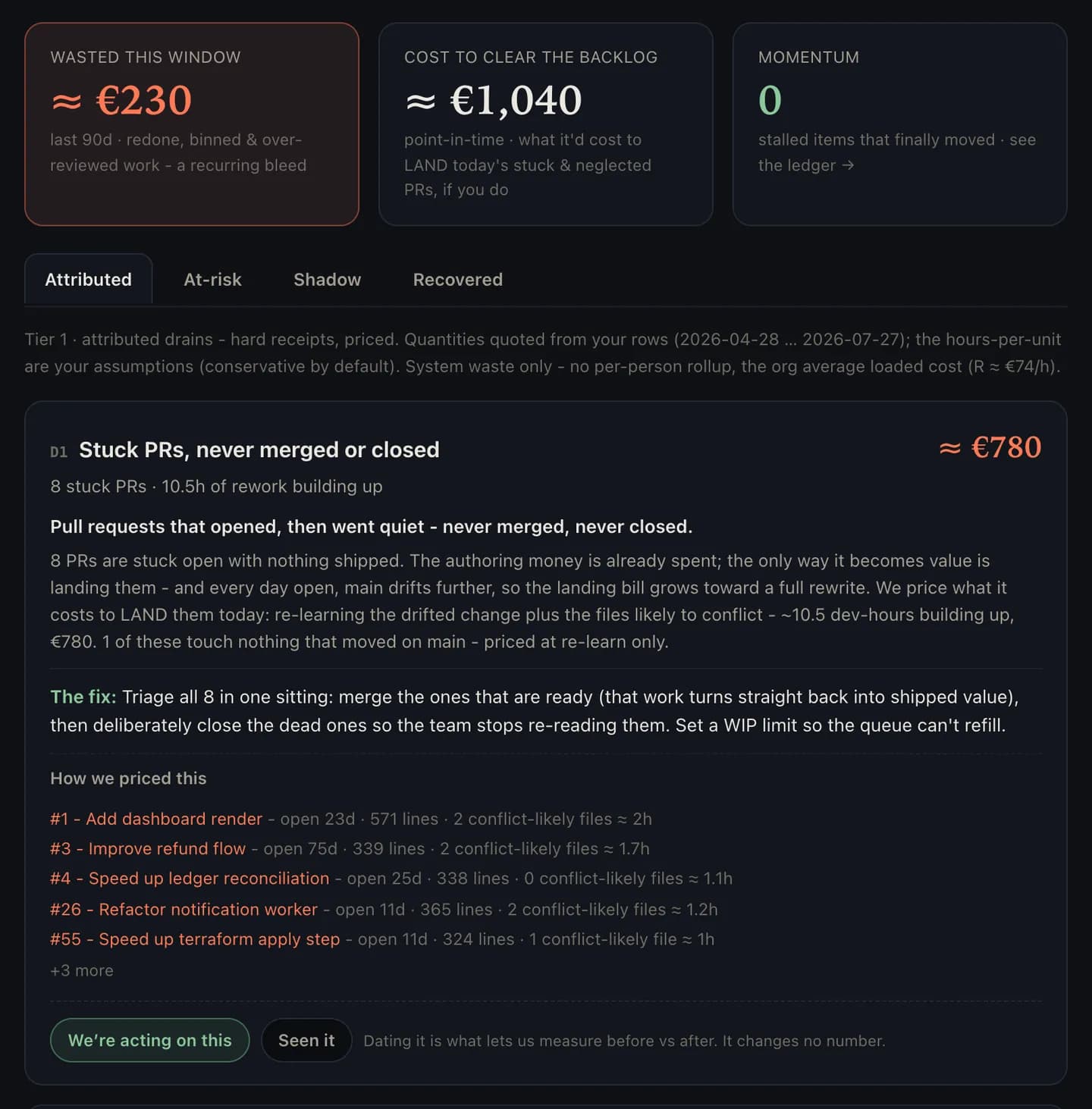
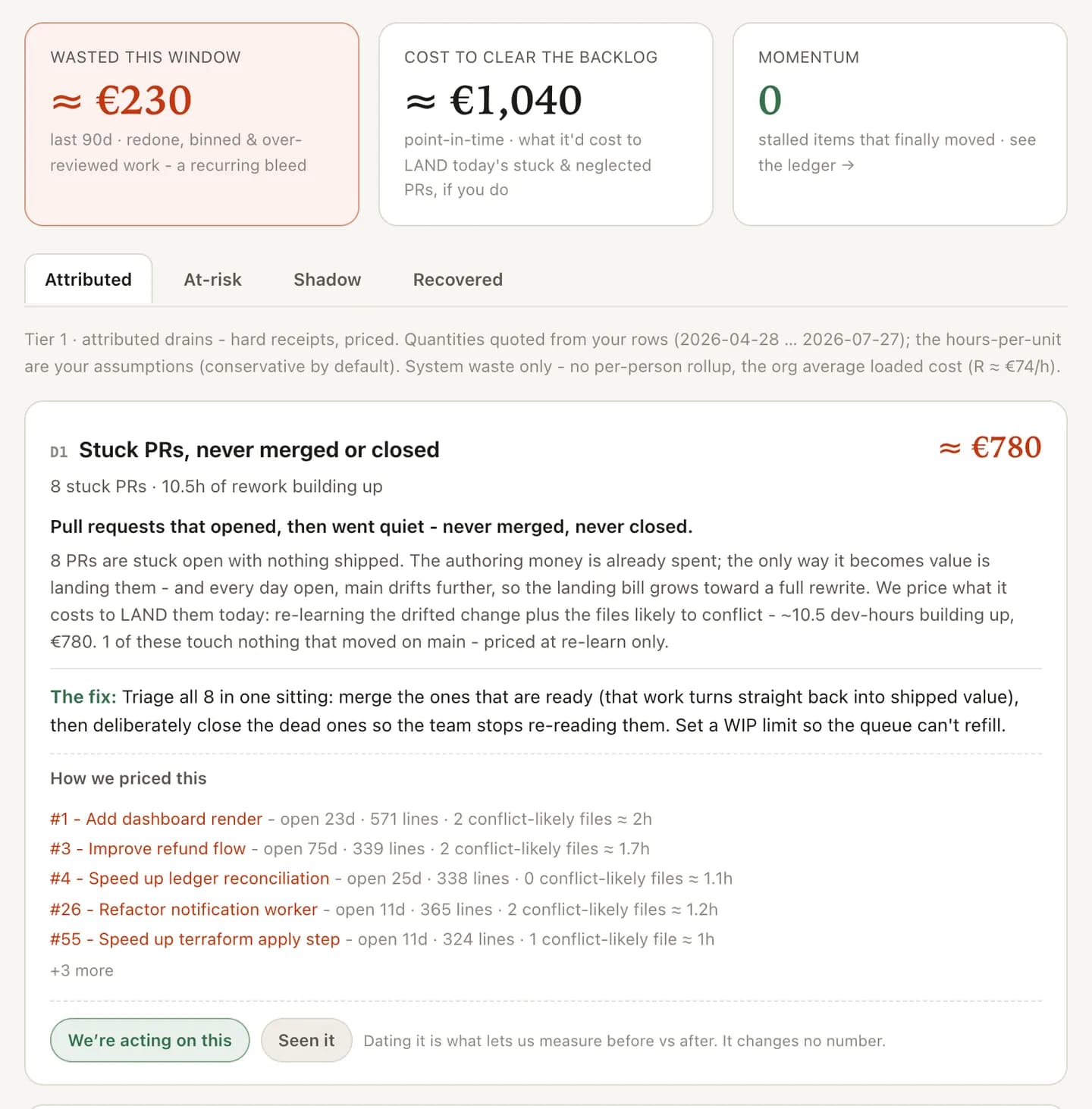
Busfactor orders named people too. Standing ranks your engineers on delivery, review, knowledge and momentum - and what hangs off that order is the entire argument. Every component opens the pull requests behind it. The weights sit on screen and switch off, so you can watch a position move and see the divisor change. A thin sample is labelled fuzzy on its own row instead of being ranked as though it were solid. An org under its own attribution level is told so, with the link to go match the identities. Anyone marked exempt from negative surfaces is out of the ordering entirely and their name never renders. Same rows in, same order out, to the byte.
What we refuse is narrower than "no scores", and more useful: no firing signal, no shame board, no bottom-N list rendered as a target. Scorecards price what losing somebody would cost, never whether to keep them.
The fine print in the attribution
GitClear's homepage describes AI attribution as "AI usage APIs plus commit heuristics plus agent telemetry hooks - not survey estimates," across six tools, marketed as commit-grade provenance. Read the middle clause twice: commit heuristics. The blend includes inference, and the per-line resolution rules aren't disclosed. It's a middle posture: more deterministic than ML fingerprinting, less strict than quoted-evidence-only, presented with the confidence of the latter. Busfactor's attribution is the narrow extreme: only evidence that signs its work counts (agent trailers, bot identities), the blind spot is disclosed on the surface, and the number re-runs byte-identically. Theirs sees more and guesses some; ours sees less and never guesses. (Setup for doing this on your own repos: how to measure AI adoption; how the whole field scores on this axis: the determinism audit.)
A microscope is not a diagnosis
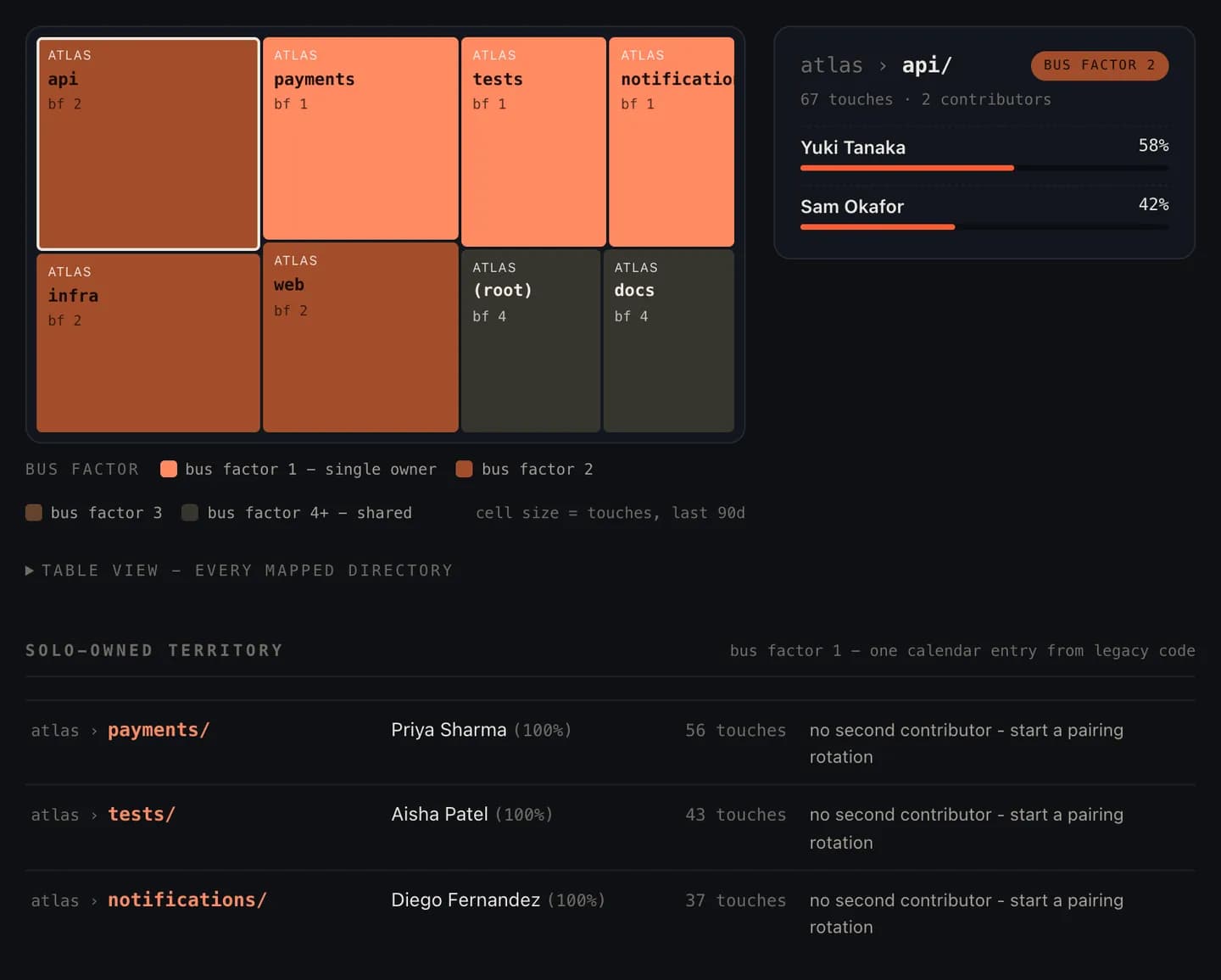
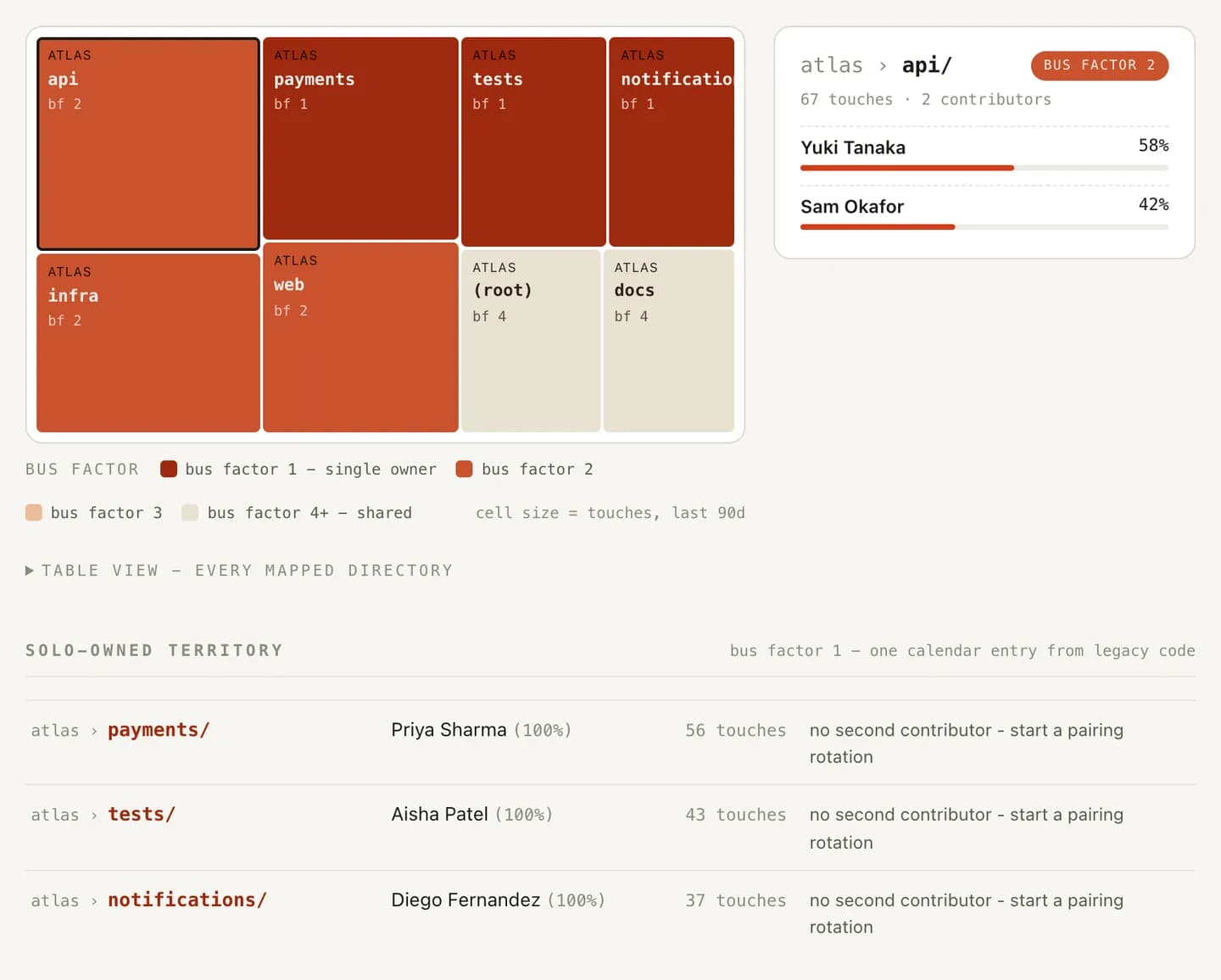
The quieter difference is scope. GitClear reads git, and only git: no issue tracker, no delivery tracing, no review-queue analysis, no knowledge-risk or bus-factor mapping, no money layer, no graded verdict - the diff under magnification, nothing upstream or downstream of it. Busfactor is the org-wide instrument: judged stats with receipts across code, reviews, tickets, and delivery in the assessment; drains and fix-payback priced in your currency on the money surfaces; knowledge-risk mapping that tells you what breaks when someone leaves; and a quarterly report card that takes a position. A microscope and a diagnosis aren't rivals so much as different instruments. But only one of them tells you what to do on Monday, and only one of them was built to be safe to point at people.
Choosing a GitClear alternative in 2026: who should pick which
| You are… | Pick |
|---|---|
| After line-grain code forensics (moved/pasted/churned) above all else | GitClear |
| A GitLab, Bitbucket, or Azure DevOps shop | GitClear (until our multi-git lands) |
| Optimizing for the lowest per-seat sticker in the category | GitClear |
| Need a per-person order the person can open, contest, and reproduce | Busfactor |
| Want tickets, delivery, knowledge risk, and money in the same diagnosis | Busfactor |
| Need a graded verdict with priced fixes, reproducible to the byte | Busfactor |
Take the evaluation questions to both demos, and add the one this matchup turns on: show me a number attached to a single person, then open it and show me the work behind it. Ours opens. Find out what theirs does before you sign.
Frequently asked
What is GitClear's Diff Delta?
GitClear's proprietary unit of code contribution. Every changed line is classified by operation and scored (copy/pasted code negative one, moved code zero, find-and-replace one, added code five, edits to code older than two weeks ten, older than a year twenty) after a filter cascade that, in their published example, removed 97.5 percent of raw changed lines as noise, plus churn and code-location scalars whose exact values and windows are proprietary. It's the deepest published line-operation methodology in the field. It is also computed and displayed per developer, which makes it a per-person productivity score. Busfactor orders named people too, on the Standing surface. The fork is whether the person in the order can open it: every component of ours links the pull requests behind it, the weights are on screen and switchable, thin samples are labelled on the row, and the same rows always produce the same order.
How does GitClear attribute AI-written code?
Their homepage describes attribution via AI usage APIs plus commit heuristics plus agent telemetry hooks, covering Claude, Copilot, Cursor, Codex, Augment, and Gemini, marketed as commit-grade provenance rather than survey estimates. The load-bearing phrase is 'commit heuristics': the blend includes inference, and the precise per-line resolution rules are not disclosed. It's more deterministic than ML fingerprinting and broader than Busfactor's approach; we count only evidence that signs its work (trailers, bot identities) and disclose the resulting blind spot rather than estimating over it.
How much does GitClear cost?
As of July 2026, per contributor per month billed annually (monthly price in parentheses): a free Starter tier (3 repos, 6-month window), Pro at $14.95 ($29), Elite at $24.95 ($39), and Enterprise at $34.95 ($49) with on-prem and SAML. All paid tiers include GitHub, GitLab, Bitbucket, and Azure DevOps. That entry price undercuts most of the category, Busfactor included at the smallest team sizes. The comparison is a cheap per-seat diff microscope versus a per-seat org diagnosis, so it depends on which instrument you actually need.
Receipts
- GitClear - Diff Delta factors (methodology page)
- GitClear - Diff Delta calculation (help docs)
- GitClear - homepage (AI attribution wording)
- GitClear 2026 - The AI Code Quality Maintainability Gap (623M code changes)
- GitClear 2025 - AI Assistant Code Quality research (211M changed lines)
- GitClear - Pricing page (as of July 2026)