Busfactor vs Hatica (2026): The $29 Question
THE $29 QUESTION
An honest Hatica alternative comparison: their $29 CapEx and wellbeing angle conceded, our audit-grade provenance and priced verdict, and who fits which tool.
The band we grade against.
Illustrative example
TL;DR: Hatica is the budget checklist vendor, and that's a real niche done honestly: DORA, dashboards, surveys, a wellbeing/maker-time angle no one else in this matchup ships, and a cost-capitalization checkbox at a $29 seat, one of the cheapest published seats carrying that feature. If per-seat price is your binding constraint, it's a rational buy. The case for Busfactor as a Hatica alternative is what the checklist leaves out: a judged verdict with receipts, money numbers an auditor can re-derive, and a stance. None of those appear at any Hatica tier. Everything below is as published in July 2026; pricing pages drift, so re-verify.
Comparing these two products is mostly comparing two shopping lists. Hatica's is long and cheap; ours is shorter, opinionated, and un-gated. What's on their list has earned real credit, so that comes first. (The vendor-neutral framework for this whole category is in the buyer's guide.)
What Hatica genuinely does better
The price ladder. From Hatica's pricing page, as of July 2026: Free (activity dashboards, DevEx surveys, automated standups, 1-month history), Pro $19/member/mo (DORA, velocity, throughput, wellbeing, goals, 6-month history, SSO), Business $29/member/mo (projects, sprints, focus and investment views, cost capitalization, SPACE, custom dashboards, exports, on-prem integrations, HRMS, 2-year history), Enterprise custom (self-host, product API, warehouse sync, 5-year history). A free tier with surveys and standups included is a genuinely low barrier, and $29 for the full analytics suite undercuts nearly everyone, Busfactor included at the smallest team sizes.
A cheap CapEx checkbox, and no longer the cheapest. Cost capitalization at a $29 seat is genuinely low for that feature, and we said "lowest published" here until we re-checked the field on 28 July 2026. It isn't, any more. Waydev gates its equivalent at $49 per active contributor (Premium, billed annually), so Hatica still wins that one. But Swarmia restructured during 2026 and now sells a single-feature Software capitalization plan at 16 € per developer per month billed annually, which lands under Hatica's $29. Oobeya and Allstacks publish no prices at all, so nobody can rank them. The honest version: Hatica is among the cheapest published seats carrying capitalization, it is not the cheapest, and the ranking only ever covered the vendors who print numbers. If you need a capitalization export and the bar is "my finance team wants something," Hatica clears it cheaply.
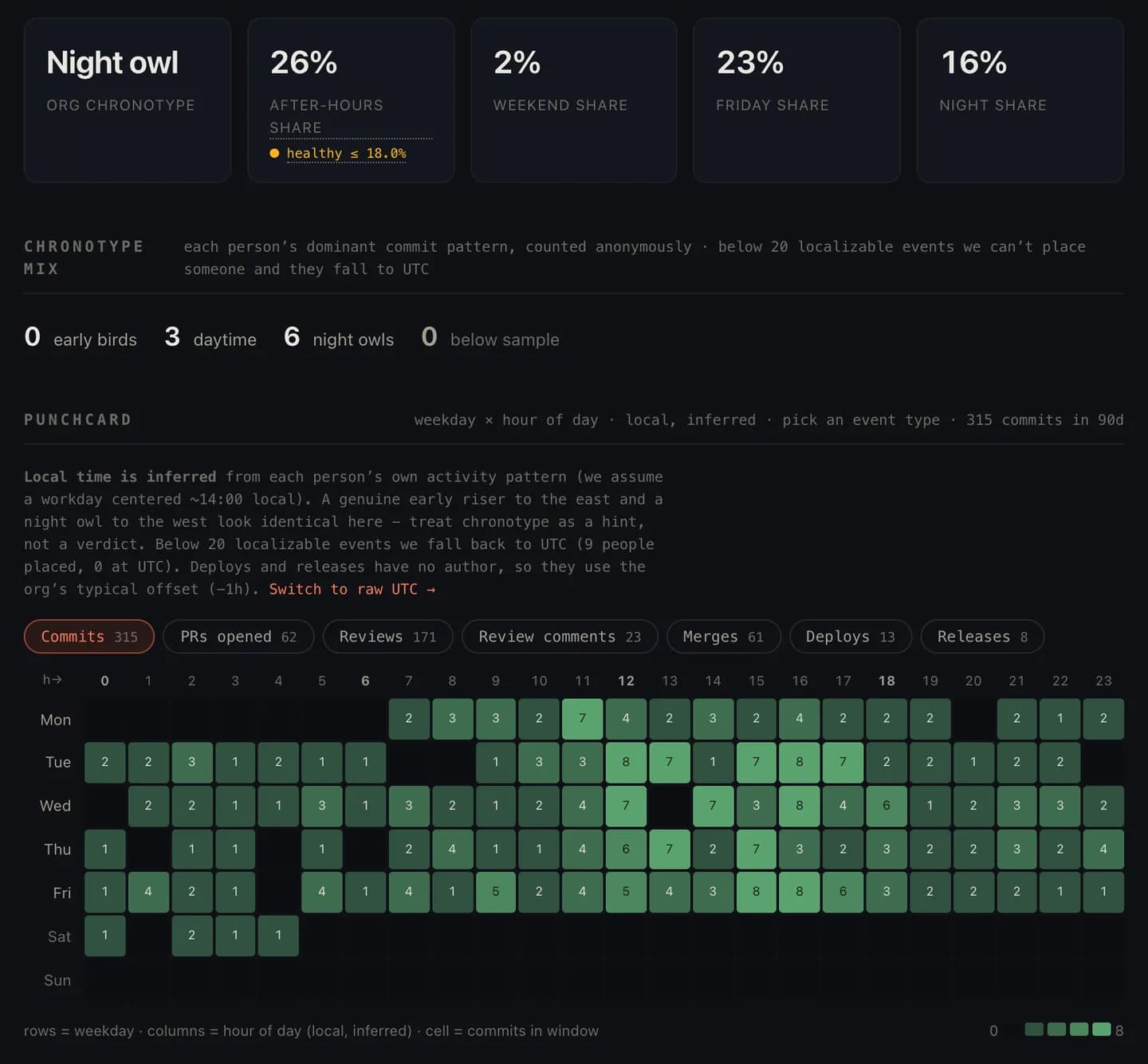
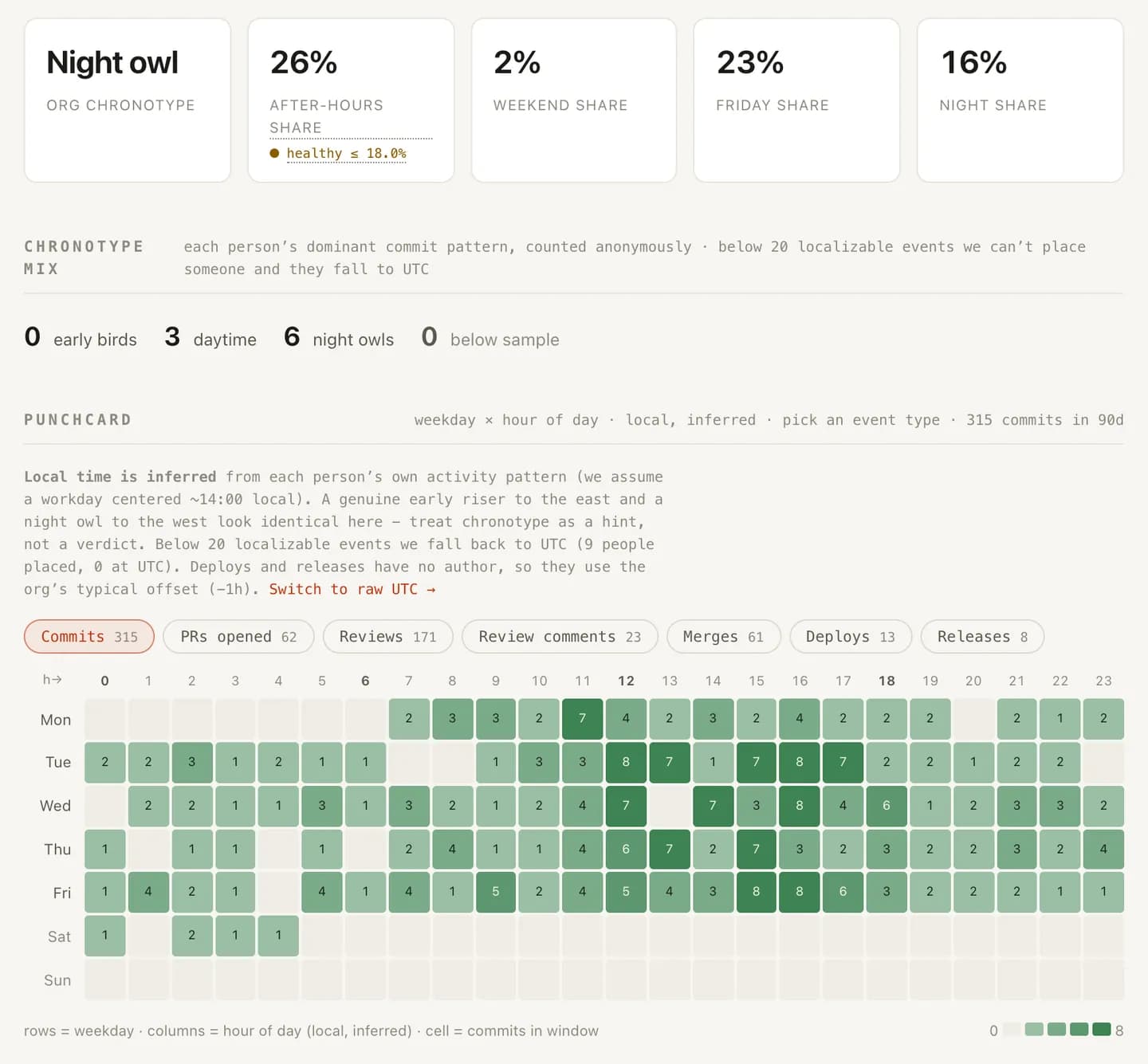
Wellbeing and maker time. Hatica's differentiator is the focus/wellbeing angle: meeting load versus maker time, drawn from calendar and collaboration integrations - they document a Google Calendar connector and a Microsoft Calendar equivalent as data sources. Busfactor deliberately doesn't ingest calendars; our after-hours and load signals are git-observable only. If calendar-based focus analytics is on your must-have list, that row goes to Hatica by forfeit.
CapEx without provenance is a spreadsheet, not an audit
The disagreement sits inside Hatica's best feature. A capitalization number exists to survive scrutiny - your auditor's, your CFO's, eventually maybe a tax authority's. Credit where it's due: Hatica does write about this. Their capitalization post describes pulling data from repos and tooling, splitting work into buckets (bugs, KTLO, technical debt, roadmap), and promises "improved accuracy, and precision of generated reports with a clear auditable trail." That's provenance of the inputs. What we could not find anywhere in their public material as of July 2026 is the rule set itself: which signals put a given pull request in the capitalizable bucket rather than the expensed one, and what happens to the boundary cases. Ask the question that matters in that meeting: if we re-ran last quarter's capitalization today, would the numbers match - and can anyone outside the vendor re-derive them? An auditable trail back to the data source is a real answer to the first half. Neither the post nor the pricing page claims the second.
Busfactor's CapEx package is built backwards from that meeting: a judged allocation taxonomy, and an export that prints its provenance (run id, engine version, ruleset version, content hash) so the same rows produce the same bytes, on demand, in front of the auditor. (Why capitalization deserves this level of rigor: CapEx vs OpEx; how the rest of the field handles number provenance: the determinism audit.)
The missing verdict, and the thin AI story
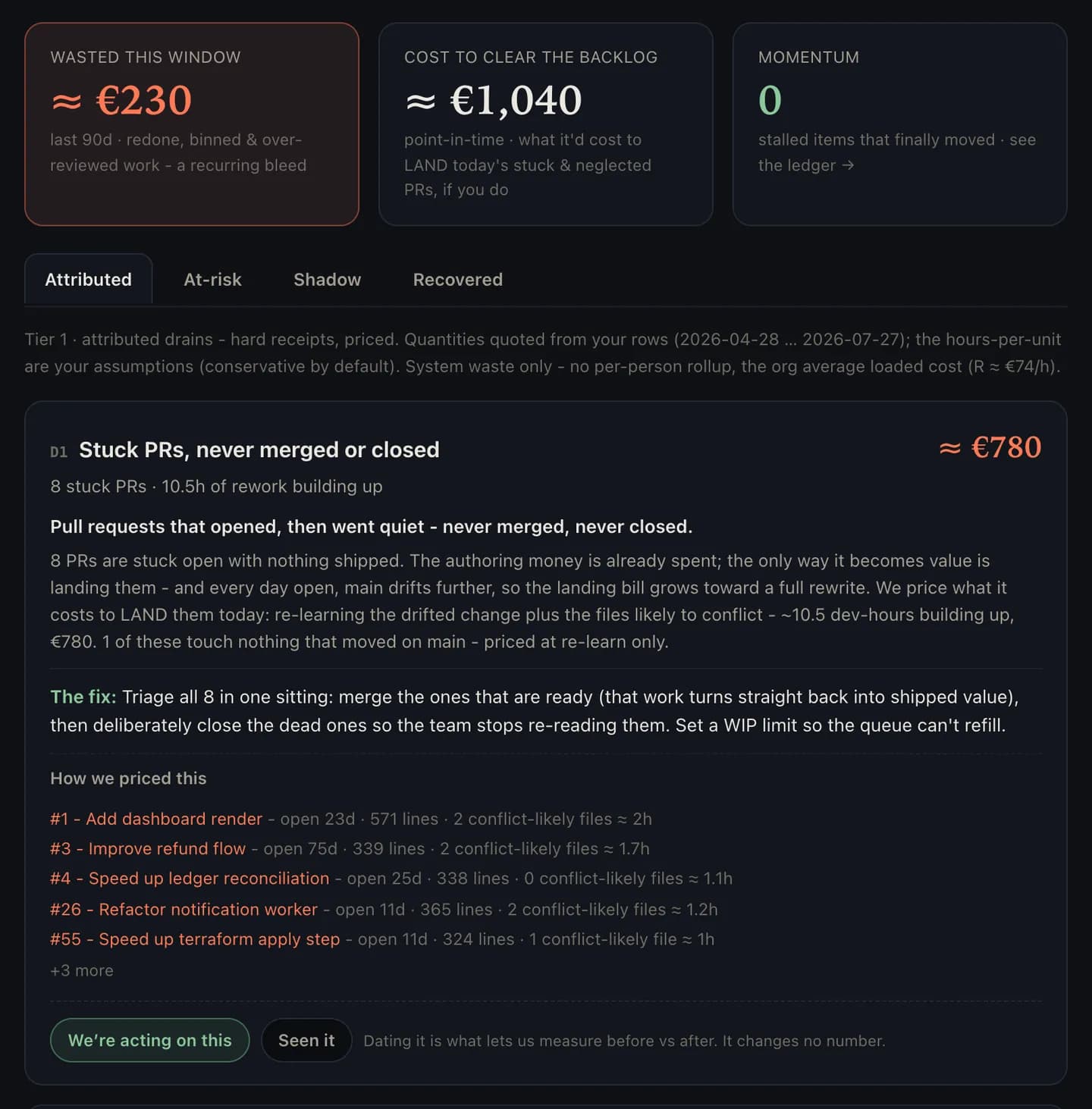
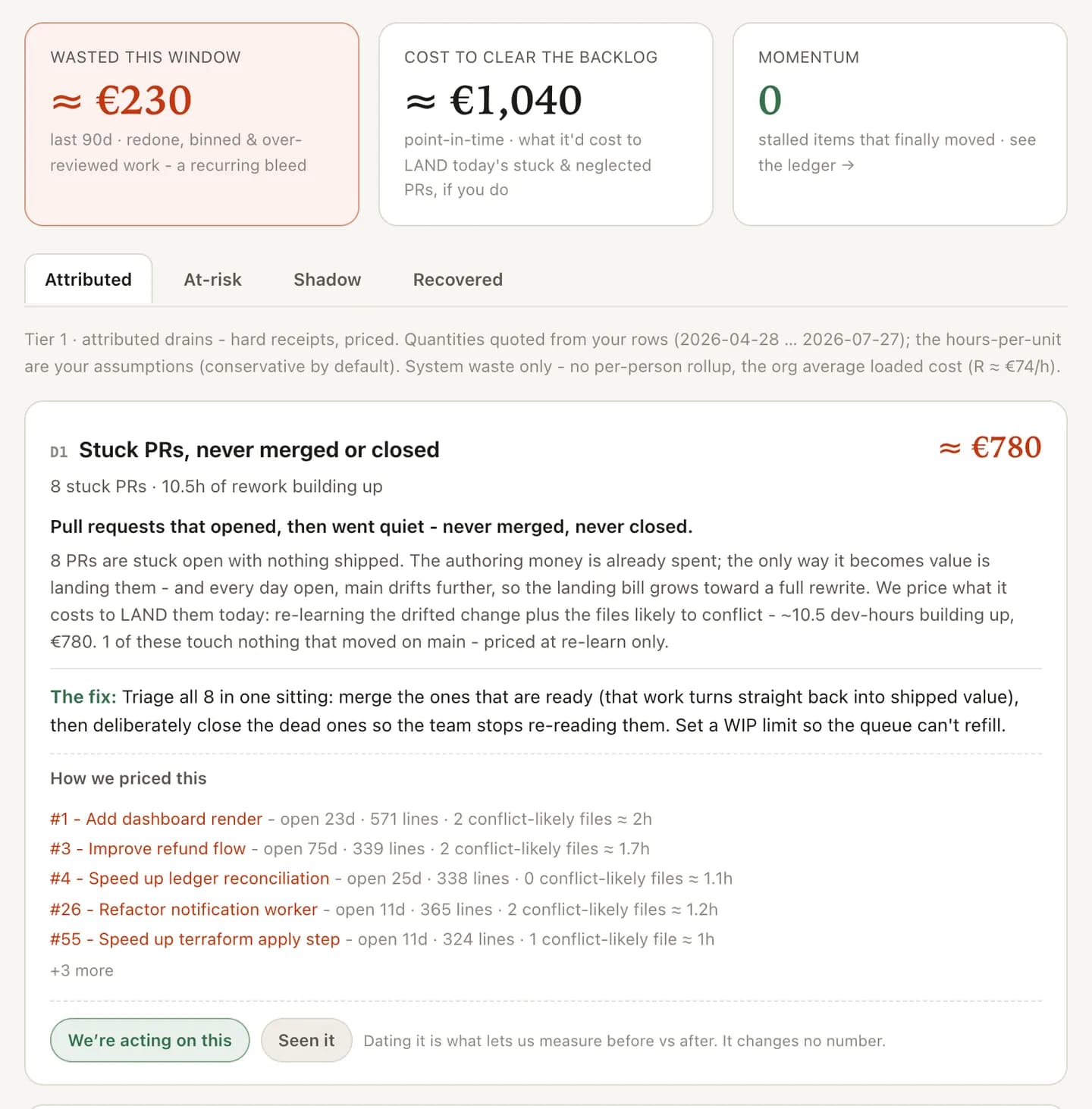
The broader difference is what happens after the dashboard loads. Hatica hands you charts - competent, numerous, and yours to interpret. There is no judged verdict, no receipts grammar linking each claim to the PRs and tickets behind it, no priced consequence, no graded quarter. Busfactor's product is that layer: the assessment takes a position on every metric against published cited bands, the money surfaces price the drains in your currency with a payback estimate on each fix, and the report card grades the quarter in time for your renewal decisions.
Two more honest observations from their own marketing, as of July 2026. First, their pricing page lists no AI-impact measurement feature at any tier. Their homepage does market "gen AI-driven insights," so the intent is clearly there; what we could not find is a priced AI-measurement capability or a page explaining what it measures. In a year when measuring AI's actual effect is the category's central question, that's a gap worth asking them about (what the measurement should look like: how to measure AI adoption). Second, to their credit, we found no individual-developer ranking, leaderboard, or per-person score marketed on Hatica's homepage or pricing page, a restraint we share and formalize: Busfactor refuses per-person composite scores outright, and ships retention-framed scorecards instead.
Choosing a Hatica alternative: who should pick which
| You are… | Pick |
|---|---|
| Constrained by per-seat budget above all else | Hatica |
| Needing calendar-based wellbeing and maker-time analytics | Hatica |
| After "a capitalization export exists" at the lowest sticker | Hatica |
| Defending CapEx numbers to an auditor who asks how they're derived | Busfactor |
| Wanting a graded verdict with receipts and priced fixes, not chart homework | Busfactor |
| Measuring AI's real impact with quoted evidence, not vibes | Busfactor |
Run the evaluation questions against both - the provenance one decides this matchup. The rest of our July 2026 comparison set: Busfactor vs Allstacks, Busfactor vs Code Climate, and Busfactor vs Oobeya.
Frequently asked
How much does Hatica cost?
As of July 2026, per Hatica's pricing page: a Free tier (activity dashboards, DevEx surveys, automated standups, 1-month history), Pro at $19/member/month (DORA, velocity, throughput, wellbeing, goals, 6-month history, SSO), Business at $29/member/month (projects, sprints, focus and investment views, cost capitalization, SPACE, custom dashboards, exports, on-prem integrations, HRMS, 2-year history), and a custom Enterprise tier (self-hosting, product API, warehouse sync, 5-year history). That is among the cheapest published seats carrying a capitalization feature, though not the cheapest: re-checked 28 July 2026, Waydev gates its equivalent at $49 per active contributor (Premium, billed annually) but Swarmia now sells a Software capitalization plan at 16 €/developer/month, under Hatica's $29. Most of the rest of the field is quote-only, so no ranking covers it.
Does Hatica support cost capitalization?
Yes, at the Business tier, $29/member/month as of July 2026 - a low published price for that feature, though Swarmia's 16 €/developer/month capitalization plan now undercuts it. What's missing is the layer underneath it. Hatica's own capitalization post promises an 'auditable trail' and work-allocation views (bugs, KTLO, technical debt, roadmap), but it doesn't publish the rules that sort work into capitalizable buckets, and neither it nor the pricing page makes a reproducibility claim. Busfactor's CapEx package is built for the audit conversation: a judged allocation taxonomy plus an export that prints its provenance (run id, engine version, ruleset version, content hash) so the same rows re-run to the same bytes.
What is the difference between Hatica and Busfactor?
Hatica is a low-priced engineering analytics checklist: dashboards, DORA, surveys, wellbeing and maker-time views from calendar and collaboration tools, and a capitalization feature; you interpret the charts. Busfactor is a diagnosis: metrics judged against published cited bands, receipts linked on every claim, drains and fixes priced in your currency, and a quarterly graded report card. Cheap breadth versus an opinionated verdict is the real choice.
Receipts
- Hatica - Pricing page (as of July 2026)
- Hatica - homepage (as of July 2026)
- Hatica blog - Automating software capitalization (their own CapEx material)
- Hatica docs - Google Calendar connector (calendar as a data source)
- Waydev - Pricing (capitalization price comparison, checked 28 July 2026)
- Swarmia - Pricing (capitalization price comparison, checked 28 July 2026)