Busfactor vs Multitudes in 2026: The Ethics Twin's Labels
THE ETHICS TWIN'S LABELS
A fair Multitudes alternative comparison: where their AI cost data and wellbeing sources win, where the High/Low adopter labels clash, and who fits which tool.
The band we grade against.
Illustrative example
TL;DR: Multitudes is the competitor we respect most: an ethics-forward analytics product with a written no-stack-rank pledge ("we'll never stack-rank developers"), shipped AI token/cost ingestion, wellbeing sources we don't have, and research caveats so honest we wish more of the category wrote like them. The honest case for Busfactor as a Multitudes alternative sits in three places: they classify each individual as a High or Low AI adopter and we refuse that grain entirely; their AI-slop feature is a lens over metrics they already had (their words: "leading indicators of AI slop") while ours is an evaluated detector; and their $20 tier sees six weeks of history while every one of our tiers reads all of it and grades the quarter. Every claim below is cited, concessions first.
Most comparison pages in this category are easy to write because the other vendor ships the thing we refuse. Multitudes is the hard one - the values twin. They got to the ethics positioning first, they mean it, and a culture-led buyer choosing between us is choosing between two products that both refuse the leaderboard. Which makes the differences the whole page. One framing note before the receipts: this is a snapshot of both products in their mid-2026 state, meaning July 2026 pricing, docs, and feature sets, each linked so you can re-check what has moved since. (The category-wide context lives in the buyer's guide.)
What Multitudes genuinely does better
- Shipped AI cost and token data. Their AI adoption measurement ingests provider usage APIs and OpenTelemetry for Claude Code, Cursor, GitHub Copilot, and Codex: tokens, cost in USD, AI-suggested lines. Busfactor doesn't ship AI spend ingestion today. They also disclose the gaps, meaning which providers lack token, cost, or lines data, instead of papering over them. That's our kind of honesty, on a feature they have and we don't.
- Wellbeing sources. Out-of-Hours Work, Page Disruptions, and Meeting Load are their wellbeing metrics, fed by documented PagerDuty and Opsgenie integrations and by Outlook and Google Calendar. The calendar integration is a source we simply don't have; our after-hours signal is git-observable only.
- Published epistemics. Their AI Impact docs admit selection bias ("people who choose to use AI more are likely different"), report "no consistent impact" from AI interventions on most metrics, and frame their expected-uplift figure (a 27.2% merge-frequency increase for high adopters) as typical variation from their research, not a promise. Most vendors bury caveats; they publish them.
- The coaching loop. Their product runs diagnose → discussion questions → recommended experiments → track. It's a genuinely good team-coaching UX with no direct equivalent in Busfactor.
- And the pricing is published and self-serve. Respect, always, in a quote-only category.
The label we refuse to print
The fork is a single label. Multitudes' AI Impact feature auto-classifies every individual into a High or Low AI-adopter cohort: by default, anyone whose work shows AI activity on 35% of days across a rolling 12-week window, a threshold they derive openly from their research. Their defense is real: under their transparency principle the developer sees the same data their manager sees, and the cohorts feed aggregate comparisons, not rankings.
But the per-person label exists. Somewhere in the system, each of your engineers is marked High or Low on AI adoption - and a label computed is a label exportable, screenshot-able, and one reorg away from becoming criteria. Busfactor's position is structural, not attitudinal: AI adoption is measured at tool, area, and org grain, and no person-grain AI cohort is ever computed, so there is nothing to leak, subpoena, or misuse. The reasoning is the same one behind our refusal of individual performance metrics generally (the moment a signal attaches to a person, the incentive to game it kills the signal), and the practical mechanics of measuring adoption without personal labels are in how to measure AI adoption.
Our scorecards do go deep on people - strengths, growth, the cost of losing someone - but nothing in them is a rankable composite, and AI usage is never a per-person score.
To be fair in both directions: this is a disagreement between two vendors who both refuse stack-ranks. Theirs is "transparent person-grain data"; ours is "no person-grain data of this kind at all." You should decide which failure mode worries you more.
"Leading indicators of AI slop," read mechanically
Their homepage promises to "spot leading indicators of AI slop": "we spot early signs of reduced code quality or if your human code review process could be missing issues in AI code changes." Read the docs behind the phrase and the mechanics are their existing quality and review metrics (PR size, change failure rate, lead time, feedback depth) reframed as leading indicators, plus a guided deep-dive into human reviews. As of July 2026 their public docs disclose no dedicated slop algorithm. That's a lens, and a reasonable one, but it's worth knowing it's a lens rather than a detector.
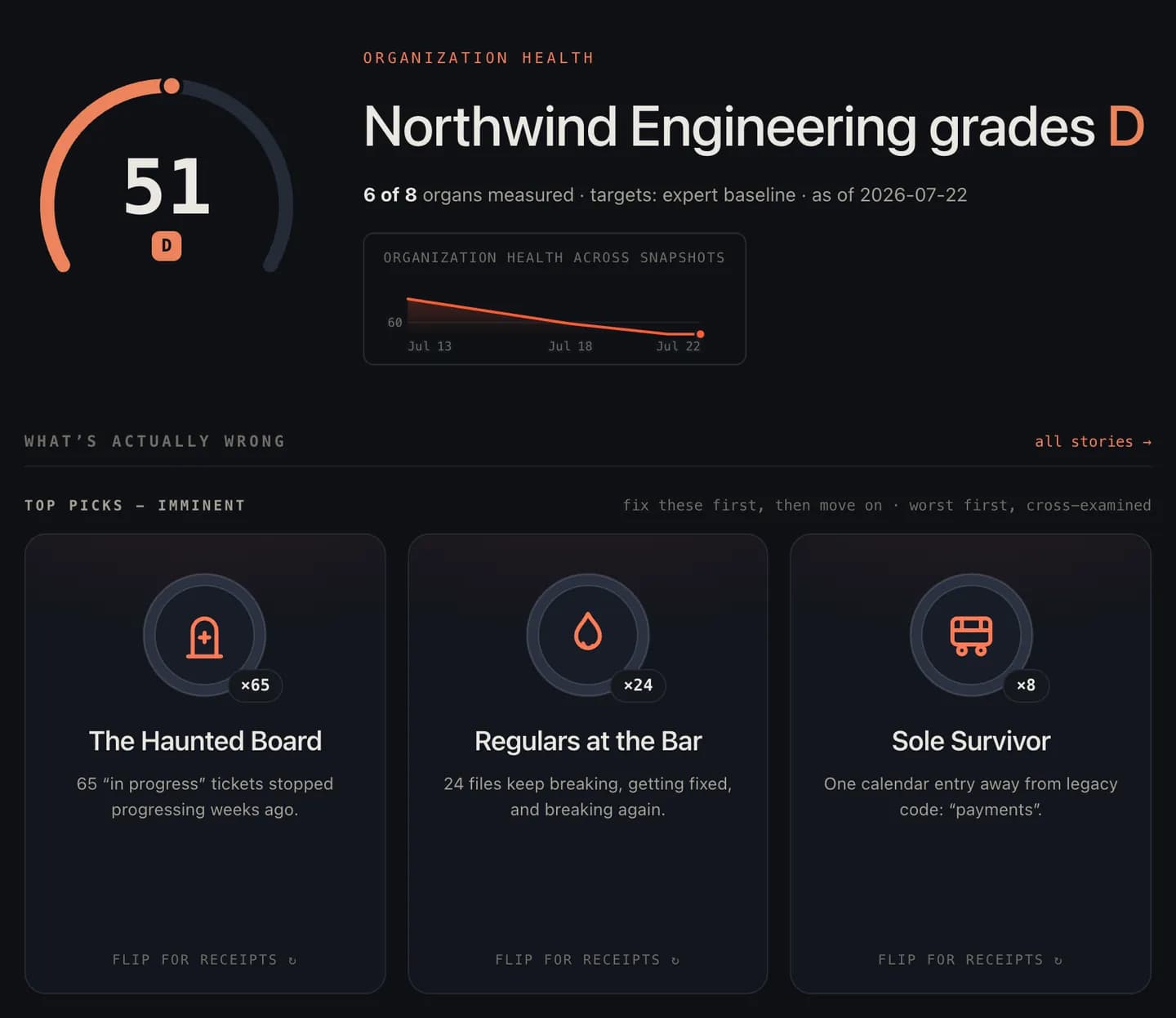
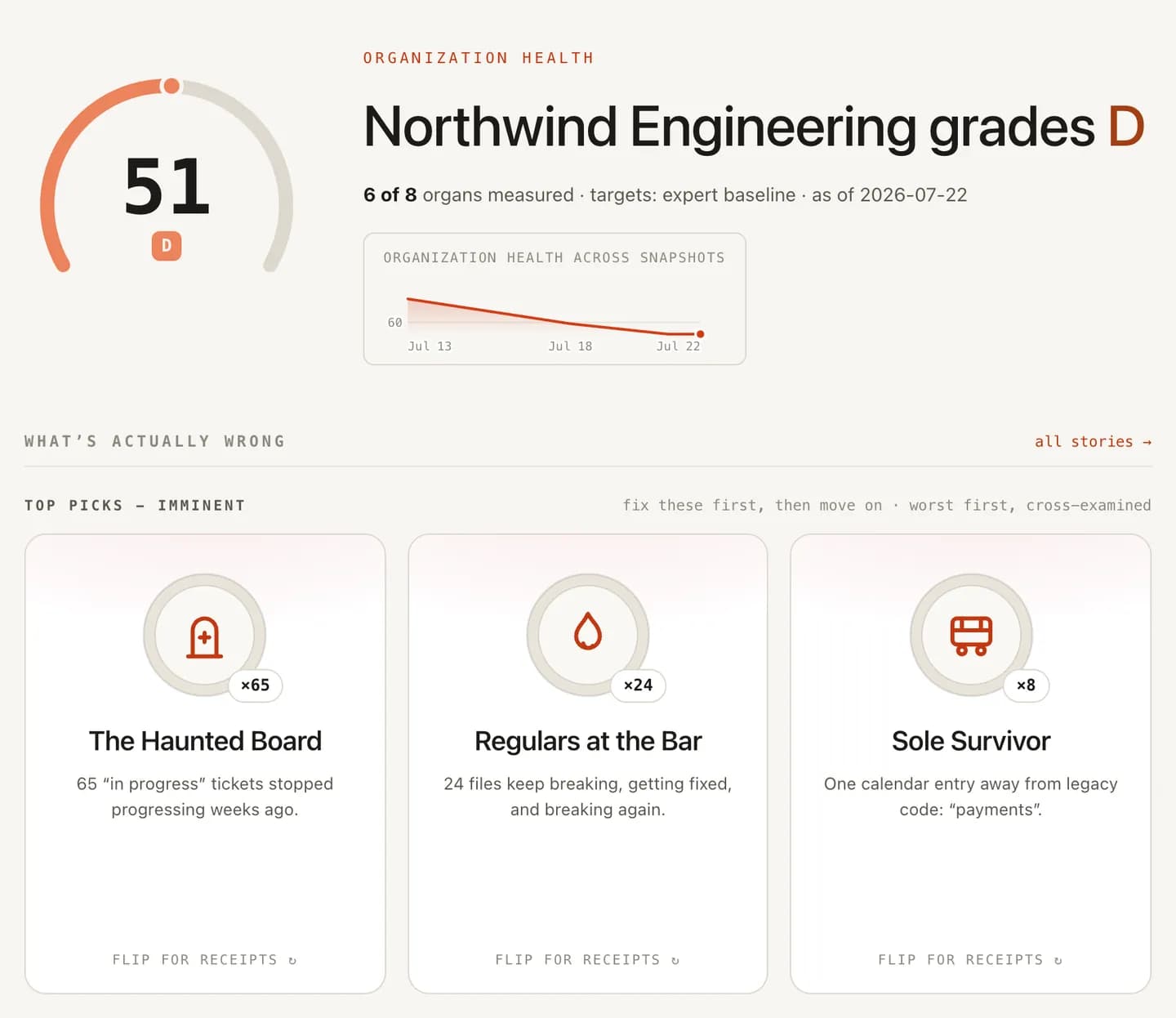
Busfactor ships a detector: the AI impact engine separates rework into in-flight iteration versus delivered-then-broken episodes, gates the slop verdict on a deterministic delta against your unattributed baseline, and was evaluated on a real engineering org before it shipped. (What slop actually is and why composition metrics under-detect it: AI slop code.) The distinction matters because a CTO needs the second question answered: is AI code breaking after delivery more than our baseline, yes or no, show me the PRs.
Six weeks of history vs a graded quarter
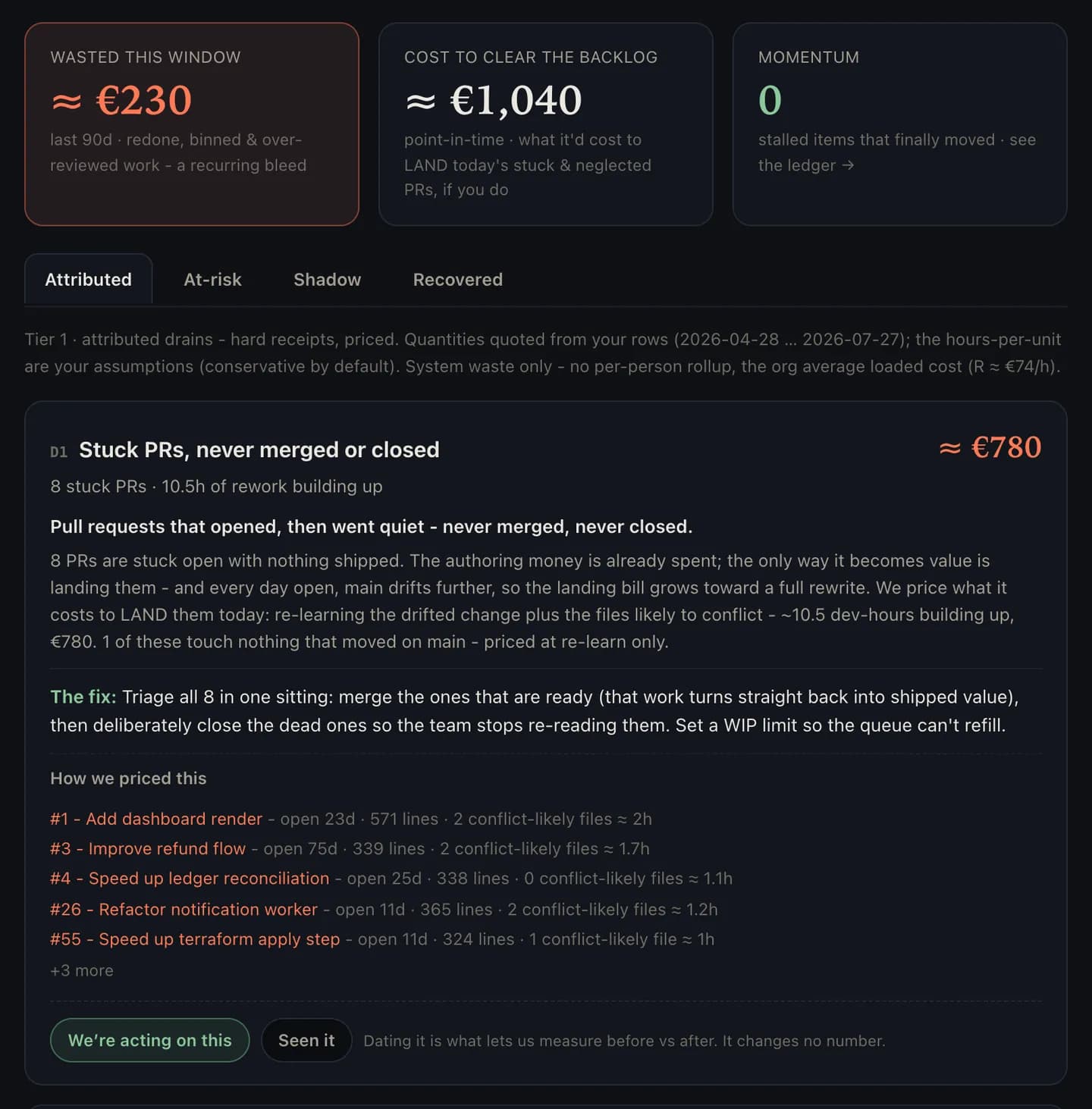
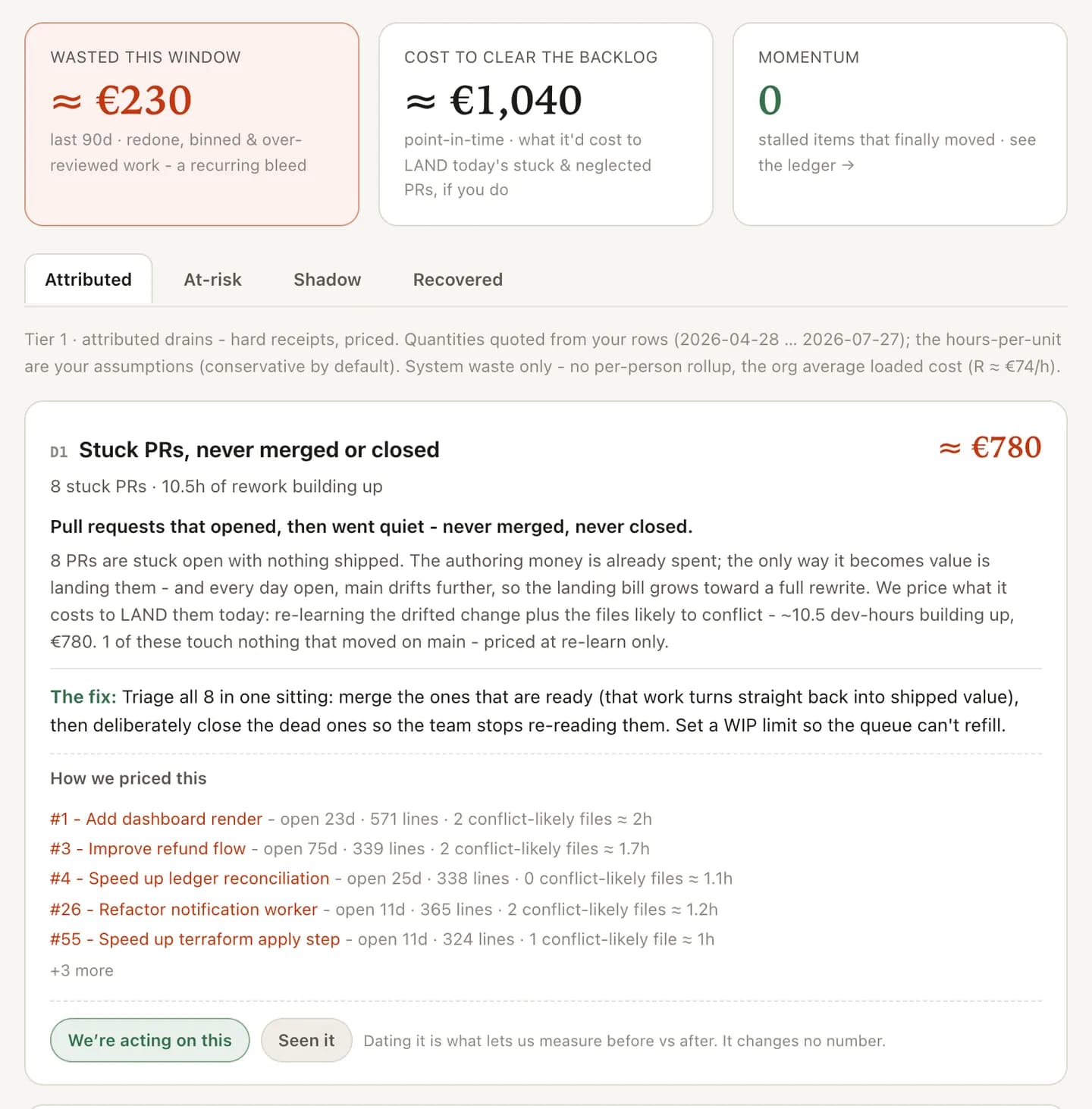
The quiet limitation in their Standard tier: only six weeks of historic data. Six weeks can show you a trend; it cannot show you a trajectory, a quarter, or a before/after around the tool rollout you did in March. Busfactor ingests your full history and turns it into judged verdicts: ~47 stats against published bands, drains priced in your currency, and a quarterly report card with a grade your leadership team can argue with. Multitudes hands you honest data and good discussion questions; Busfactor hands you a stance with receipts and a payback estimate on each fix. Their loop ends in an experiment; the assessment ends in an invoice for the drain and a door out of it. Both are defensible products, just different answers to "what should Monday's leadership meeting do with this?"
The re-run test also separates us: we found no reproducibility or re-run claim in their public docs as of July 2026, and two of their collaboration metrics have a model inside. Feedback Quality and Feedback Themes are classified by Multitudes' own AI models, which they say are "specifically designed to mitigate algorithmic biases and are grounded in research." They publish the categories and the reasoning, which is more than most of the field does. What they don't publish is the model, the prompts, the thresholds, or a validation you could re-run - so those two numbers can't be re-derived from outside. Busfactor's exports print run id, engine version, ruleset version, and content hash, so "same rows in, same bytes out" is a check you can run yourself. The full vendor-by-vendor picture is in the determinism audit.
Who should pick which
| You are… | Pick |
|---|---|
| Need AI token/cost spend data from provider APIs today | Multitudes |
| Want calendar-based meeting-load and pager wellbeing signals | Multitudes |
| Want a facilitation product - discussion questions, experiments, team coaching | Multitudes |
| Unwilling to have any per-person AI-adopter label exist, even a transparent one | Busfactor |
| Need more than six weeks of history without the enterprise tier | Busfactor |
| After graded verdicts, priced drains, and byte-identical re-runs | Busfactor |
If your shortlist is exactly these two, you've already decided the ethics question - both of us pass it, differently. Run the evaluation question list against both, and add one question of your own: "show me every place a number attaches to an individual person, and what controls exist on each." Their answer will be honest. So will ours.
Frequently asked
Does Multitudes stack-rank developers?
No, and they say so in writing: 'We show the same metrics to leaders and devs, and we'll never stack-rank developers.' That pledge is real and their transparency model backs it. The nuance a buyer should know: their AI Impact feature does classify each individual into a High or Low AI-adopter cohort, by default anyone active on 35% of days over a rolling 12-week window. Under their transparency rule the person sees their own label, but the per-person label exists: the grain Busfactor refuses to compute at all.
How does Multitudes measure AI usage?
From provider usage APIs and OpenTelemetry, not commit analysis: Claude Code, Cursor, GitHub Copilot, and Codex. A person counts as active on a day if their work used tokens, created cost, changed AI-suggested lines, or accepted/rejected suggestions. Their docs disclose the gaps honestly: Copilot exposes no token or cost data, Claude Code Enterprise lacks tokens and cost, Codex lacks lines-changed, and provider data arrives aggregated daily in UTC. Busfactor measures the other side: AI signals in the shipped work itself, deterministically, with the blind spots disclosed.
How much does Multitudes cost?
As of July 2026, their published pricing is $20 per contributor per month for Standard (all analyses including AI impact, but only 6 weeks of historic data) and $45 for Enterprise (SSO, compliance reports, CSM), with a $5,000 minimum invoice for bank-transfer payment on Enterprise plans and a 2-week free trial with no card required. Busfactor is priced per active developer with published tiers and full-history ingestion, so the real comparison is per-seat with a six-week window versus per-seat with your whole history, at a lower rate.
Receipts
- Multitudes - Our Product (data ethics, diagnose→experiment loop)
- Multitudes docs - AI Adoption (data sources, active-user definition)
- Multitudes docs - AI Impact (High/Low adopter cohorts, thresholds, caveats)
- Multitudes docs - AI Impact feature overview (provider data gaps)
- Multitudes docs - metrics and definitions index (collaboration, wellbeing)
- Multitudes - homepage (AI slop detection framing)
- Multitudes - Pricing (as of July 2026)
- Multitudes docs - Feedback Quality (AI-model classification, categories)
- Multitudes docs - PagerDuty integration (wellbeing source)
- Multitudes docs - Opsgenie integration (wellbeing source)
- Multitudes docs - Outlook Calendar integration (meeting-load source)