Busfactor vs Navigara (2026): Who's Actually Deterministic?
WHO'S ACTUALLY DETERMINISTIC
Hover or focus to flip ↻A cited Navigara alternative comparison: what their docs say about the LLM behind ETV, what we refuse to build, and which teams each product actually fits.
TL;DR: Navigara is the rival that markets our own vocabulary, "deterministic, not probabilistic," with impressive enterprise posture for a young company and genuinely transparent pricing. It's also, per its own documentation, a product that requires an LLM backend whose classifications feed the flagship score, benchmarks that score per developer, and a formula with named factors but unpublished weights. This page quotes their pages precisely, including where their claims are stronger than ours, and labels the one place we infer rather than quote. Then it tells you who each tool actually fits.
Navigara is the most interesting head-to-head in our category, because on the surface we're selling the same thing: engineering output measured from artifacts, CapEx from real work records, no surveys, honest-sounding language about determinism. The differences are all in the machinery, which is exactly where a buyer should look. (Context for the whole category's determinism claims: the audit.)
What Navigara genuinely does better
They've earned real concessions, so those come first:
- Enterprise posture at seed stage. Their site lists SOC 2 Type II for cloud SaaS, SCIM and SSO in every mode, and three deployment models up to air-gapped on-prem. Busfactor holds none of those certifications today. If procurement needs them this quarter, that row is theirs.
- Shipped chat interface. Slack and MS Teams natural-language Q&A with citations is live. Ours isn't yet. When it ships it will be quote-only by construction, but a shipped feature beats a designed one.
- There's also a live cohort: Industry Pulse aggregates "anonymized adoption data from 200+ engineering teams" with peer-indexed targets. Our benchmark bands are published, cited references rather than live percentiles.
- Provider breadth: five git providers and three issue trackers, per their docs, plus AI-cost ingestion over OpenTelemetry. Busfactor is GitHub-first today.
- Transparent pricing. Published and self-serve, as of July 2026: $30/developer/month, a $4,500 one-off on-prem Audit, a free 14-day trial with 1,000 PRs analyzed. In a quote-only category, publishing prices deserves respect - it's the same bet we made.
- Finance framing. Their CapEx/OpEx page names the actual standards (IAS 38, ASC 350-40, ASC 985-20), demos policy restatement across 28 reconstructed quarters, and offers IRC Section 41 R&D-credit studies. We don't do restatement or tax-credit studies today; determinism would make ours stronger when we do, but theirs exists now.
The determinism question, quoted precisely
Here is the load-bearing issue, in their own three sources:
- The ETV methodology post (defensive framing): a language model is used "only to classify ambiguous work into categories, not to invent the number," and "the weighting is deterministic: the same diff produces the same score on every run."
- The AI ROI page (candid framing): ETV is "scored straight from commit history by LLMs, ML, and algorithms."
- The deployment docs (operational truth): an LLM backend is required (Vertex AI by default, AWS Bedrock or Azure AI Foundry as alternatives, Anthropic Claude models recommended), used for commit analysis, summaries, and AI-code detection.
What follows from those pages without any inference: classification is LLM work, and classification is load-bearing. Every change lands in exactly one of Growth, Maintenance, or Fixes; the bug-fix multiplier only fires on changes recognized as fixes; the CapEx policy rules map LLM-tagged activity types to accounting treatment. Deterministic arithmetic, fed by model-classified inputs.
And the one inference we'll make, labeled as such: because the LLM backend and model are customer-configurable and model versions retire, we don't see how two runs across time or across customers are guaranteed to classify identically, and we found no model-pinning, classification-caching, or reproducibility documentation anywhere in their public docs as of July 2026. That's a question, not a verdict: ask them to re-run last quarter and match it byte-for-byte. It's the same test we invite on our own exports, which print run id, engine version, ruleset version, and content hash precisely so the test is performable.
One secondary consequence worth raising in a demo: peer benchmarks aggregated across customers whose classification layers run on different, customer-chosen model backends are softer than the percentile presentation suggests. Ask how cohort uniformity is maintained.
The per-developer score
Navigara's feature table lists benchmarking "across teams, repos, and developers," and its landing page publishes org-average ETV-per-developer figures for outside organizations - OpenAI and Vercel among them - that never opted in. Precision matters here, so: those published figures are org averages, not named individuals, and we have not seen a public screenshot of a sortable per-person ranking table in-product. But benchmarking developers on a single composite output unit is the per-person score pattern, and it ships with no anonymization system, no guarded-people design, nothing between the number and an HR misuse.
The research case against that pattern (individual performance metrics, stack ranking) is the reason Busfactor refuses it outright: our scorecards frame people by strengths, growth, and the cost of losing them, and no surface computes a rankable composite per human. Some buyers want the ranking. We lose those deals on purpose, and you should know which buyer you are.
One number vs a diagnosis
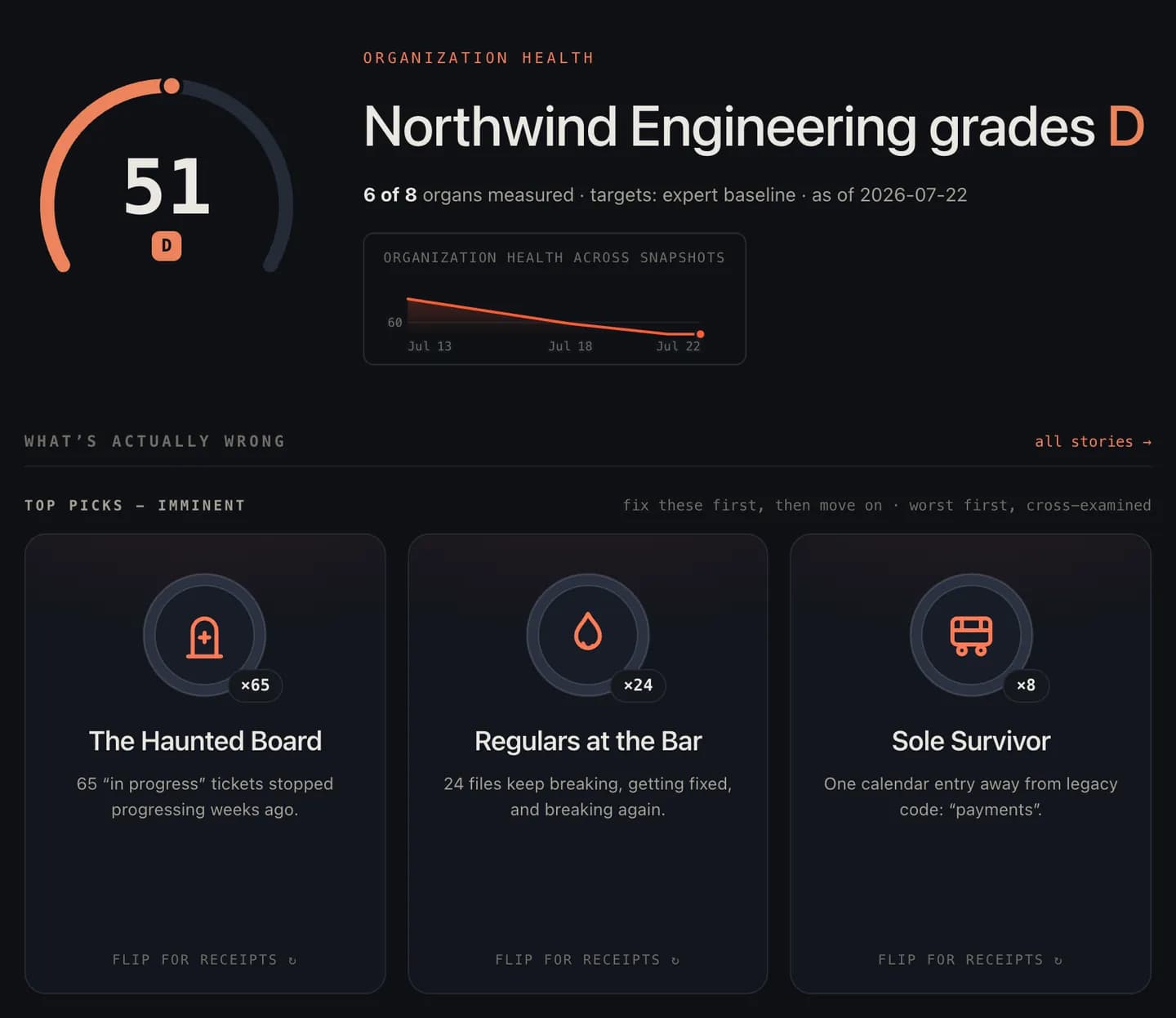
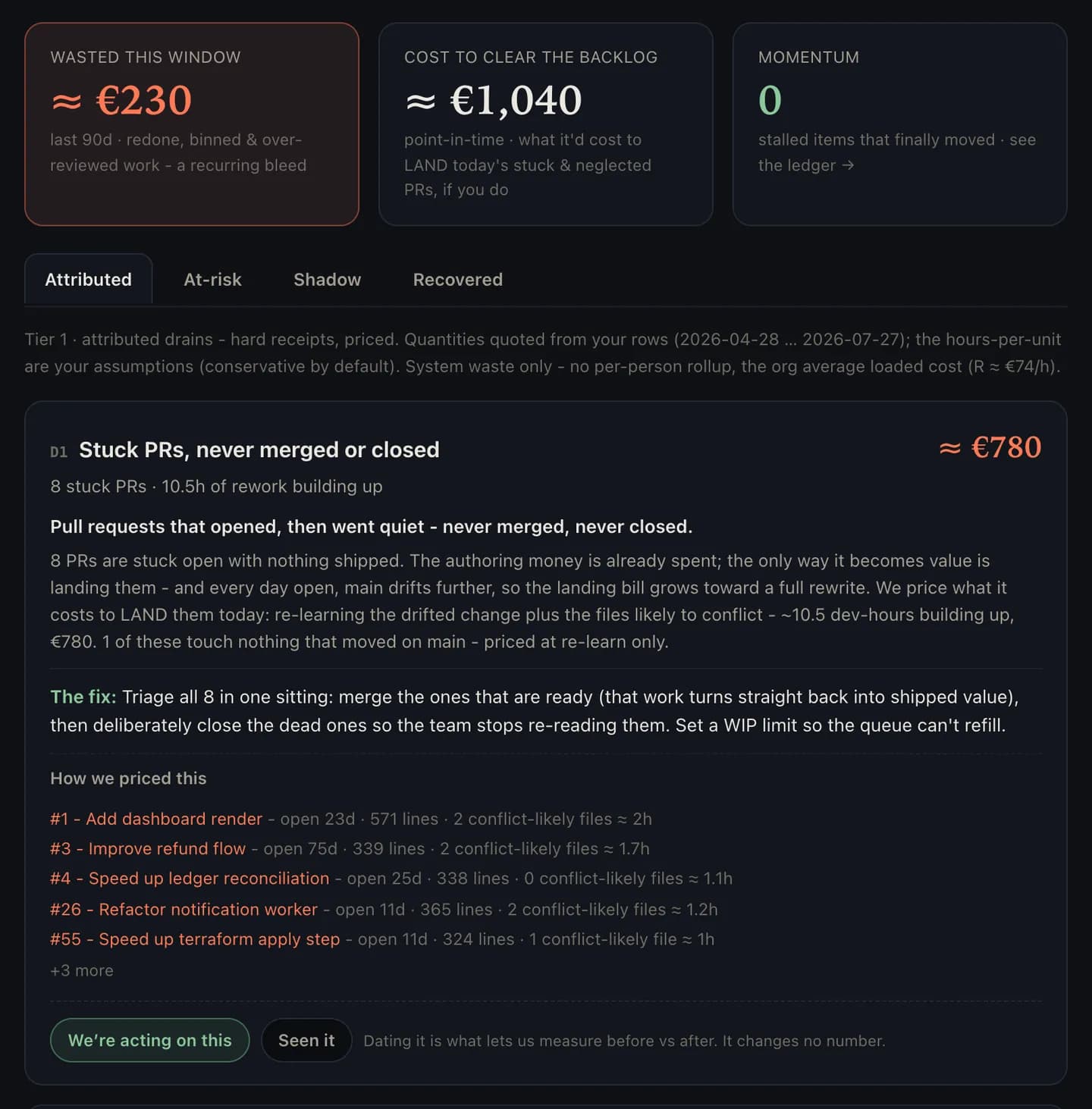
ETV's genuine appeal is narrative efficiency: output went up or down, one unit, one chart. What a single output unit cannot tell you is why. Navigara has no review-friction analysis, no knowledge-risk mapping, no rework taxonomy separating healthy iteration from delivered-then-broken code, no per-item wait analysis, and an explicitly anti-survey stance. Busfactor's bet is the opposite: ~47 judged stats with receipts, drains priced in your currency, a payback estimate on every prescription, and a quarterly graded report card: the full assessment. "Your throughput index moved" and "your review queue is burning six figures a year and here are the PRs" are different products. Theirs is a speedometer; ours is the mechanic's diagnosis with the invoice attached.
Who should pick which
| You are… | Pick |
|---|---|
| Blocked on SOC 2 / SCIM / air-gapped on-prem today | Navigara |
| GitLab/Bitbucket/Azure DevOps estate | Navigara (until our multi-git lands) |
| Sold on one output unit + live peer targets as the operating rhythm | Navigara |
| Unwilling to put model-classified inputs inside CapEx and org scores | Busfactor |
| Opposed to per-developer benchmarking on principle (or on legal advice) | Busfactor |
| After the why - friction, knowledge risk, priced drains, graded quarters | Busfactor |
Both vendors publish prices, both self-serve, both will take the same question list. Start, as always, with the buyer's guide framework, and make both of us demonstrate the re-run. Only one of us will do it live.
Frequently asked
Is Navigara deterministic?
Their methodology post says the weighting is deterministic and that a language model only classifies ambiguous work into categories. Their AI ROI page says ETV is scored by 'LLMs, ML, and algorithms,' and their deployment docs require an LLM backend (Vertex AI, Bedrock, or Azure) to run the product. Since the Growth/Maintenance/Fixes categories the LLM produces feed the score, the fair summary is: deterministic arithmetic over model-classified inputs, with no public model-pinning or reproducibility documentation we could find. Ask them the re-run question directly.
What is ETV (Engineering Throughput Value)?
Navigara's proprietary unit of engineering output: each merged change is read file-by-file from git diffs and commit metadata, weighted by five disclosed factors (complexity, engagement, architecture, decay, multiplier), and bucketed into Growth, Maintenance, or Fixes. The factor names are published; the weights, the aggregation math, and the normalization behind the 'pre-AI = 100' index are not. It's an elegant narrative device, one number for output, that you cannot re-derive from public material.
How do Navigara and Busfactor prices compare?
Navigara publishes transparent self-serve pricing. As of July 2026: $30 per developer per month, billed to anyone who committed during the period, plus a $4,500 one-off on-prem Audit and a free 14-day trial capped at 1,000 analyzed PRs. Busfactor is priced per active developer with published tiers, so it is a straight rate comparison: both bill per developer, ours starts lower, and neither our tiers nor our history carry a cap.