Busfactor vs Typo in 2026: The Neighbor That Reviews PRs
THE NEIGHBOR THAT REVIEWS PRS
An honest Typo app alternative comparison: their AI reviewer, MCP server, and price conceded; our verdict layer, money spine, and receipts contrasted.
The band we grade against.
Illustrative example
TL;DR: Typo is our PLG neighbor: self-serve, adjacent price band, aimed at the same CTO who won't sit through a sales cycle. It also ships two things we deliberately don't. One is an act-layer, an AI code reviewer with inline fixes. The other is a shipped MCP/Ask-AI surface that plugs its data into Claude Code and Cursor workflows. For a 30-dev startup that wants a reviewer and metrics in one $28 seat, it's a reasonable buy and we'll say so. The honest case for Busfactor as a Typo alternative: their AI-impact classifier is a black box without even a methodology post, AI usage and cost are scored per individual with "AI champions" on top (the leaderboard pattern we refuse), and there's no money spine, no graded verdict, and nothing that survives a re-run test. Cited, concessions first.
Typo brands itself "Engineering Intelligence for the AI Era": measure AI's impact, then act on it. The acting is the interesting part. Where most of the category (Busfactor included) observes and prescribes, Typo also intervenes in your PRs, so the fork here goes past epistemics into something more concrete: do you want your metrics vendor writing review comments? Both products ship fast. Treat this as a mid-2026 snapshot - features and prices as of July 2026, every claim linked to its live source. (The category-wide map is in the buyer's guide.)
What Typo genuinely does better
- The act-layer. Typo's Pro tier ships AI code reviews built on "a living graph of your codebase," "fully codebase aware - not just diffs," pairing AI with SAST and proposing inline fixes and PR summaries. Busfactor doesn't act on your PRs by design; we diagnose the review system rather than participate in it. If "one vendor for metrics AND a reviewer" is the ask, that row is theirs, cleanly.
- Their MCP server and Ask AI are shipped, not roadmap. The NL surface answers questions over code, PRs, deployments, and team performance, and the MCP server feeds Typo's data into Claude Code and Cursor agent workflows, which is a genuinely smart distribution move. Busfactor has no NL interface today. When ours ships it will be quote-only by construction, but shipped beats designed.
- Rounded PLG package. DevEx surveys with anonymous pulse check-ins, sprint analytics (carryover, scope creep, WIP), delivery forecasting, benchmarks, and a 14-day trial without a card at a price band adjacent to ours. Their onboarding polish is real competition, and we treat it that way.
The classifier without a methodology page
Typo's AI impact page integrates Copilot, Cursor, and Claude directly, then classifies AI code into Maintenance, Performance, New Features, and Bug Fixes. How? The page doesn't say. No methodology post, no signal definitions, no error discussion. Marquee claims like "2x faster identification of AI-related quality regressions" arrive with no stated method behind them. This is the same black-box family our determinism audit documents vendor by vendor, except Typo discloses even less than the vendors who at least blog about their models.
Busfactor's AI attribution is the opposite trade, stated plainly: only deterministic evidence counts (agent trailers, bot accounts, agent branch patterns), the measured share is disclosed as a floor because tab-completions leave no trace, and the same inputs produce byte-identical outputs with the provenance printed on the export. Narrower coverage, checkable number. Their number covers more and can't be re-derived. Pick your trade knowingly; the mechanics of doing it honestly are in how to measure AI adoption.
"AI champions" is a leaderboard
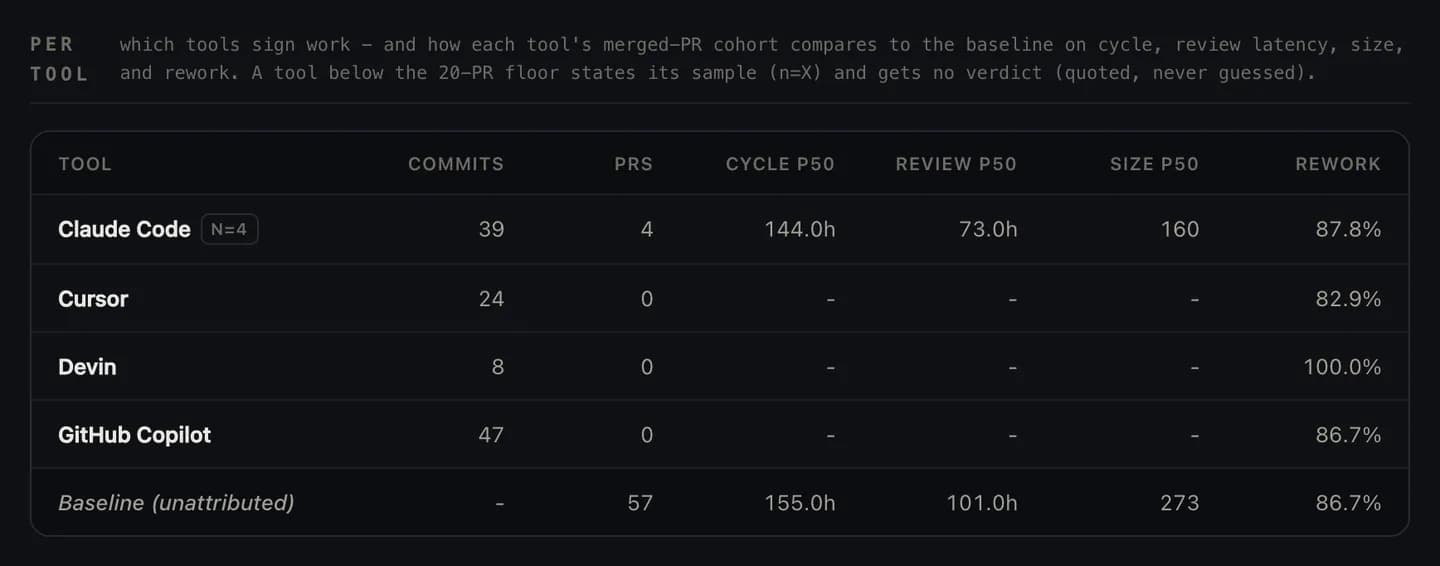
Typo tracks AI usage and cost "by team, individual, tool, and model" and surfaces your "AI champions." Read that as what it is: per-person AI scoring with a podium. The moment adoption attaches to individuals, two things die. The metric goes first, because people manage their attribution signals once a score watches them. The trust of the engineers who didn't ask to compete goes more quietly. The research case is in individual developer performance metrics; our position is structural: AI measurement at tool, area, and org grain only, no per-person AI usage or cost figure computed anywhere, and scorecards that frame people by strengths and the cost of losing them. Never a champion's podium with an implied bottom step.
What Busfactor has that Typo doesn't
- A money spine. No part of Typo prices anything. Busfactor's money surfaces express drains in your currency, attach a payback estimate to every prescription, and ship an audit-grade CapEx package with printed provenance. When the board asks "what is this costing us?", charts don't answer.
- A verdict layer. Typo shows metrics with goals and benchmarks; Busfactor judges ~47 stats against published bands and grades the quarter in a report card. Opinionated, evidence-linked, arguable - a stance, not a dashboard.
- The system-risk lenses have no Typo equivalent at all: knowledge risk and bus-factor mapping, docs health, review-friction taxonomy, and the per-item delivery trace - where each piece of work waited and behind whom.
Pricing, side by side
As of July 2026, from Typo's pricing page: Starter $20/dev/mo billed annually; Pro $28 (AI code reviews, hybrid AI + SAST, code health, unlimited history); Enterprise custom (on-prem, multi-git-org, audit logs). Billable = committed code in the past 30 days. Busfactor's per-developer tiers are on the pricing page: everything in every tier, no seat cap, history never capped. Both bill per developer, so the comparison is a rate check plus a scope check - their unlimited history sits in Pro, ours is in every tier including the free one. Run both at your actual headcount, and note the two aren't mutually exclusive: Busfactor's AI-reviewed-share metric reads review-bot activity from AI reviewers exactly like theirs.
Who should pick which
| You are… | Pick |
|---|---|
| Want an AI reviewer and metrics from one vendor, one seat price | Typo |
| Want your eng data exposed to Claude Code / Cursor via MCP today | Typo |
| A small team optimizing for PLG polish and setup speed | Typo (trial both - ours is fast too) |
| Allergic to per-person AI scoring and champion leaderboards | Busfactor |
| Need costs, drains, and CapEx someone can re-derive | Busfactor |
| After a graded diagnosis with receipts, not another dashboard | Busfactor |
Then do what we suggest against every vendor including ourselves: take the evaluation question list, ask both of us how the AI numbers are computed and whether they re-run identically, and watch which answers come with a method and which come with a shrug.
Frequently asked
Is Typo a good engineering intelligence tool?
For a specific buyer, genuinely yes: a startup or mid-size team that wants DORA and flow metrics AND an AI code reviewer in one seat, self-serve, at a PLG price. The reviewer is 'fully codebase aware,' pairs AI with SAST, and proposes inline fixes - an act-layer Busfactor deliberately doesn't ship. The honest criticisms are different: the AI-impact classifier discloses no methodology, AI usage and cost are tracked per individual with 'AI champions' surfaced, and there's no finance layer, no judged verdicts, and no reproducibility claim.
How does Typo measure AI impact?
Via direct tool integrations - Copilot, Cursor, Claude 'and more' - turning AI code activity into usage and cost tracked by team, individual, tool, and model. It classifies AI code into Maintenance, Performance, New Features, and Bug Fixes, but the classifier's mechanics are not disclosed, and headline claims like '2x faster identification of AI-related quality regressions' ship without methodology. Busfactor's attribution is the opposite posture: deterministic signals only (agent trailers, bot accounts), disclosed blind spots, no per-person AI scoring, and numbers that re-run identically.
How much does Typo cost?
As of July 2026, published pricing: Starter at $20 per developer per month billed annually; Pro at $28 (adding AI code reviews, hybrid AI plus SAST checks, code health, unlimited history); Enterprise custom with on-prem and multi-git-org support. There's a 14-day free trial without a card, and a billable developer is one who committed code in the past 30 days. Busfactor is priced per active developer with published tiers, so it's a straight rate comparison at your headcount - with the note that our history is uncapped on every tier, including free.