Jira Hygiene: Make Your Ticket Data Worth Reading
YOUR TICKETS ARE LYING
Your delivery metrics are only as honest as your tickets. A practical Jira hygiene playbook: fewer states, real timestamps, and habits that survive a sprint.
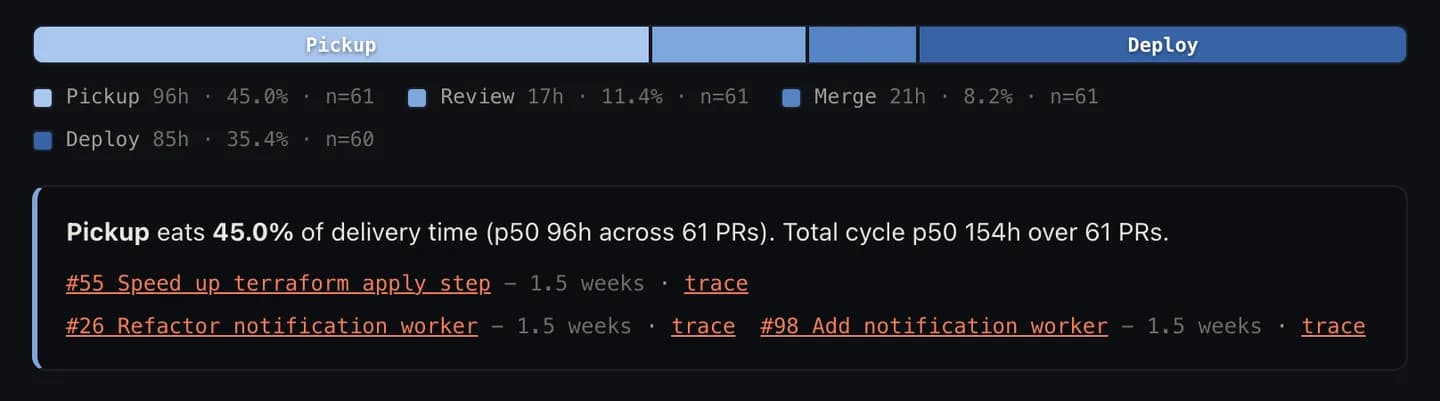
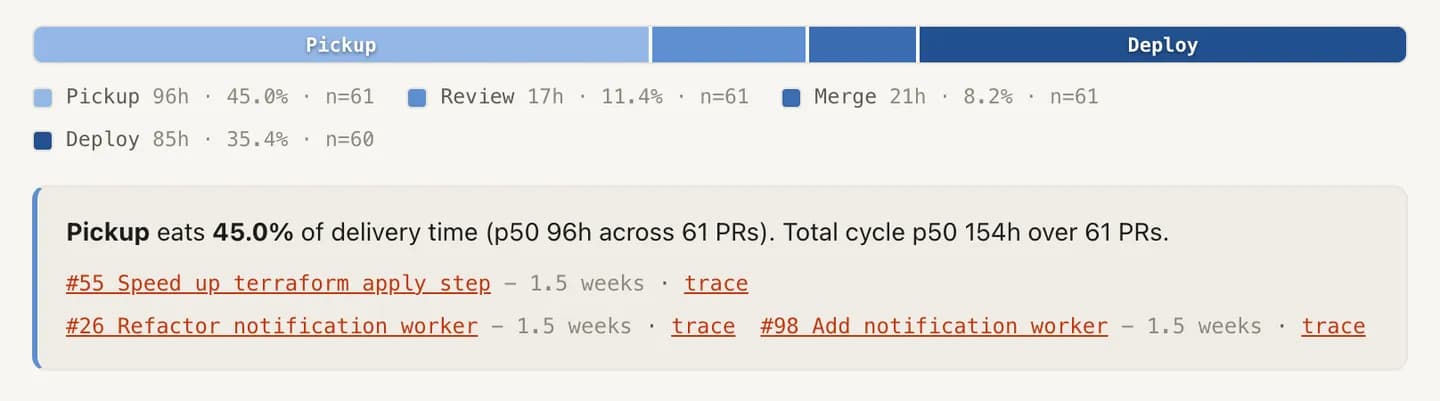
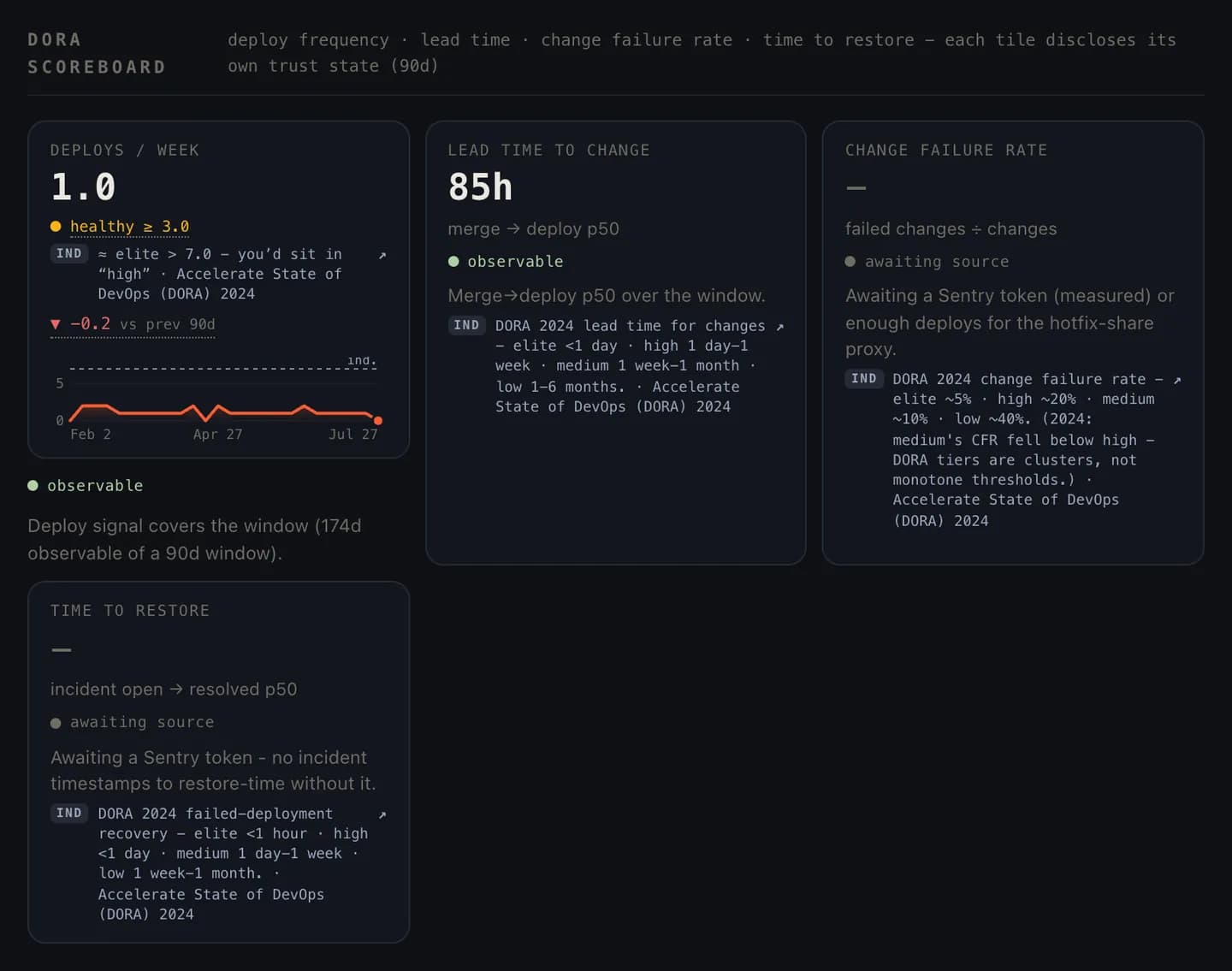
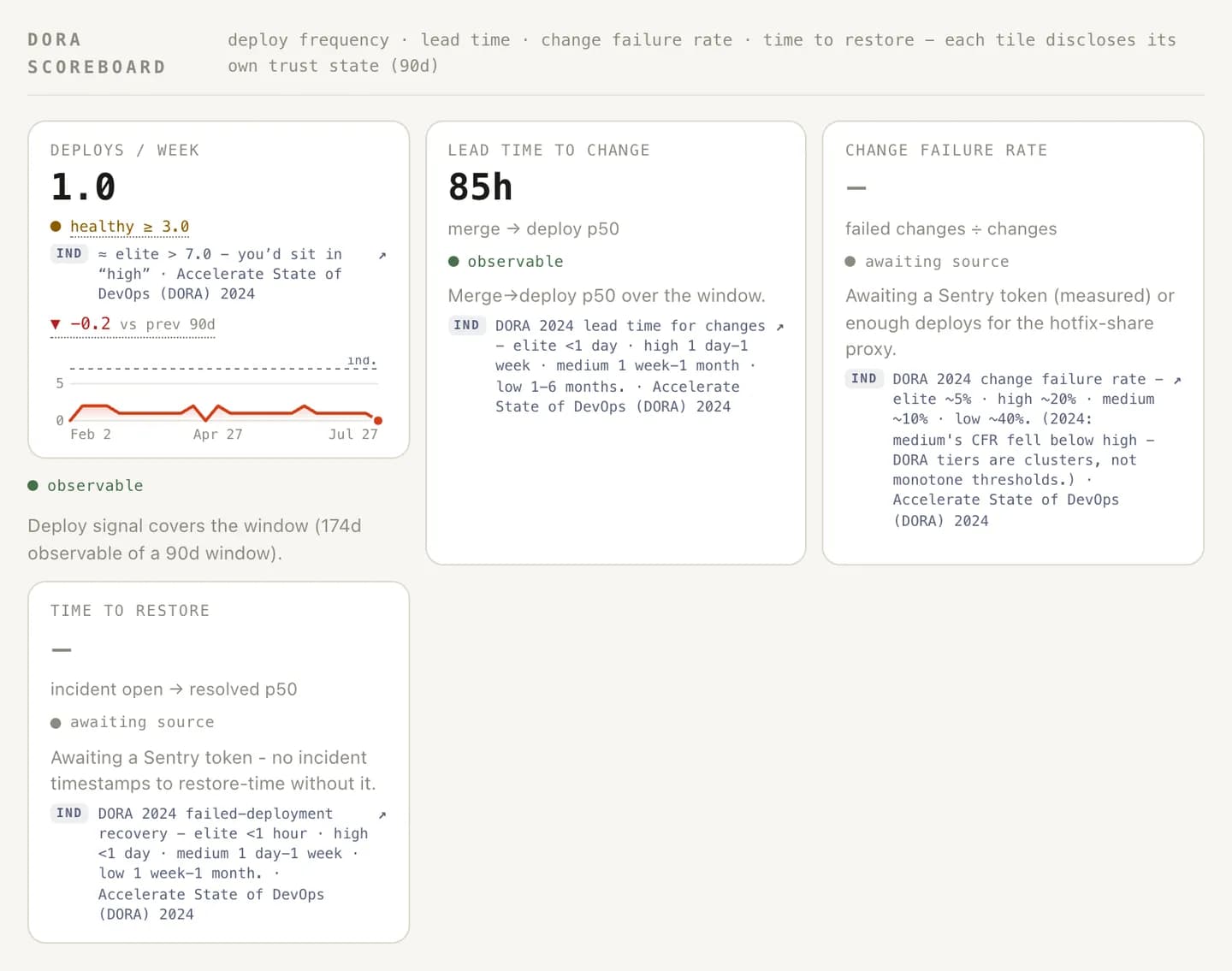
Flat and well above the elite reference - a signal, not a verdict.
Illustrative example
TL;DR: Every delivery metric you will ever compute is derived from timestamps humans left in a tracker. Cycle time, flow efficiency, blocked time, throughput: all of it. Jira hygiene is the unglamorous discipline that makes those timestamps true. States that mean what they say, boards updated when work moves rather than at standup confession time, tickets linked to PRs, a backlog that isn't a landfill. Nobody gets promoted for it. It quietly decides how much of your metrics program is fiction.
There are two kinds of engineering organizations: the ones whose tracker roughly describes what's happening, and the ones with a ticket that's been "In Progress" since March. Both kinds buy dashboards. Only one kind gets the truth out of them.
What is Jira hygiene?
Jira hygiene is keeping ticket data accurate enough that it can be read later. The term travels; the same discipline applies in Linear, Shortcut, or GitHub Projects. Readable means a state transition happened when the work actually changed hands, a ticket exists for the work that actually occurred, and "Done" means whatever your team's definition of done says it means.
The tracker is your delivery system's memory. Ask "why did this take five weeks?" six weeks later and human recollection is gone - the timestamps are all that's left. The cycle-time stage breakdown that answers the question is computed entirely from them. Garbage transitions in, confident garbage out.
Why ticket hygiene decides whether your metrics lie
Start with an asymmetry worth staring at. PR telemetry is machine-stamped. Opened, first review, merged: nobody has to remember to record any of it. Credible industry benchmarks exist for PR stages (LinearB's tables are built from 8.1M+ PRs across 4,800+ teams), and no equivalent table exists for "time in In Progress." Ticket timestamps are human-entered, and human-entered data drifts toward whatever is least annoying to enter.
The drift has a consistent shape:
- "In Progress" means "claimed." The state change happens at sprint planning; the work starts Thursday. The wait-before-work stage, often the widest queue in the whole flow-efficiency decomposition, silently books itself as active work.
- Transitions happen in batches. The board gets trued up before standup or at sprint end, so every stage duration is quantized to "whenever we last felt guilty."
- Blocked is invisible. The ticket sits in "In Progress" while its owner waits three days for another team, and the delay gets billed to the developer instead of the dependency.
- Done is negotiable. Merged-but-not-deployed, deployed-but-not-verified, "done except the migration." Each variant quietly redefines every completion metric you report.
None of this is laziness. It's what happens when data entry has no visible reader. So skip the discipline theater. Make the data worth reading, then read it where the team can see the payoff, like a retro with receipts.
There's a second payoff besides metrics: tickets are part of your team's answer trail. In the 2024 Stack Overflow survey, 61 percent of respondents said they spend more than 30 minutes a day searching for answers or solutions. A ticket that records what was decided and why it closed is a search result. A ticket that says "fixed" is a dead end with a timestamp.
The Jira hygiene checklist
- Fewer states, each a real handoff. Every column answers "who or what is this waiting on?" If two states are updated by the same person at the same moment, they're one state wearing two outfits.
- Move the card when the work moves. The whole practice compresses to this habit. A board that's true within a day produces stage timings you can act on. Trued up weekly, it produces noise.
- Make Blocked a first-class state - with an age. Blocked time billed to "In Progress" hides your dependencies and slanders your developers. A visible, aging blocked column turns "waiting on the other team" into a managed queue instead of an excuse.
- Link the PR to the ticket. It stitches the human-entered story to the machine-stamped one, and it's the difference between "the ticket closed" and "here's the code that closed it" when someone asks in a year.
- Done means the written definition. Pick where your done-line sits (merged? deployed? verified?), write it down, and stop letting each ticket renegotiate it. A done-line nobody agreed on shows up later as tickets that keep getting reopened: work you counted as finished, back for a second budget.
- Close zombies honestly. A ticket nobody will ever do is sediment. Close it as won't-do with one line of why. A backlog you refuse to prune becomes a place where real signal drowns.
- One owner at a time. Shared ownership of a ticket means nobody moves the card. Handoffs are transitions; record them.
- Estimate consistently or don't estimate. Half-estimated backlogs poison every roll-up that touches them, including whatever velocity is telling your planning meeting.
Hygiene without ticket theater
Hygiene has a failure mode on the other side: process maximalism, where the tracker grows mandatory fields like a ship grows barnacles. The test for every field, state, and required dropdown is simple. Name its reader. Who reads this, and what decision changes when they do? No reader, no field.
Two guardrails keep it honest. First, hygiene serves the system's memory. The moment board timestamps become a personal activity audit, people will rationally game them, and you'll have paid the process cost to destroy the data anyway. Roast the queue, never the person standing in it. Second, keep the maintenance loop small. A ten-minute weekly scrub while WIP is capped beats any quarterly cleanup crusade, because the truth is still warm.
The payoff is a tracker you can interrogate. Where does work wait? What's aging in blocked? How long is the walk from "started" to "shipped"? These are the questions the whole delivery-metrics scoreboard exists to answer. Clean data won't make your team faster by itself. It makes the slow part findable - and that's the step every fix has in common.
Frequently asked
What is Jira hygiene?
Jira hygiene is the discipline of keeping tracker data accurate enough to be read later: states that mean what they say, transitions that happen when the work actually moves, tickets linked to the code that shipped them, and a backlog that reflects intent rather than archaeology. It applies to any tracker: Jira, Linear, or a spreadsheet with opinions.
Why does ticket hygiene matter for delivery metrics?
Because most delivery metrics are computed from ticket state transitions. Cycle time, flow decomposition, and blocked-time analysis all read the timestamps humans left behind. If 'In Progress' really means 'on my list,' every downstream number is fiction with a decimal point. The metric pipeline is only as honest as the slowest board update.
How many workflow states should a board have?
As few as you have real handoffs. Every state should answer one question: who or what is this item waiting on right now? States that exist for reporting aesthetics rather than actual transitions don't get updated, and unupdated states are where timestamp truth goes to die. Start from To Do, In Progress, In Review, Blocked, Done, and defend every addition.
How often should you clean up the backlog?
Little and often beats heroic and quarterly. A ten-minute weekly board scrub (move what moved, flag what's blocked, close what nobody will ever do) keeps the data honest at the moment it's cheapest to remember the truth. A quarterly cleanup is a memory test the whole team fails together.