What Is Engineering Intelligence? A Plain-English Guide
WHAT IT CAN NEVER TELL YOU
Hover or focus to flip ↻Engineering intelligence explained in plain English: what these platforms measure, how they differ from DORA dashboards, and what they can never tell you.
TL;DR: Engineering intelligence is business intelligence pointed at how software gets built. Platforms in this category read the systems your team already uses - git, tickets, CI, code review - and compute answers to the questions every engineering leader is currently answering with vibes: how long changes really take, where knowledge is dangerously concentrated, what AI adoption is doing to the code, and what the friction costs. The good ones show receipts for every claim. The bad ones show you a score.
Your engineering org writes its own diary every day. Every commit, review comment, ticket transition, and CI run is a timestamped, attributed record of how work actually happened, as opposed to how the status report says it happened. Engineering intelligence is the discipline of actually reading that diary.
What is engineering intelligence?
Engineering intelligence (you'll also see "software engineering intelligence" and the older "engineering analytics") is a category of tools that connect to an engineering org's existing systems and turn raw activity data into diagnosis: metrics, trends, anomalies, and, in the better implementations, concrete findings with the evidence attached.
The name is borrowed deliberately from business intelligence. BI took the position that a company's operational data, properly assembled, answers questions better than the loudest person in the meeting. Engineering intelligence applies the same position to software delivery, where the resistance to measurement has historically been stronger. To be fair to the resisters, the measurement has historically been worse.
The category exists because the questions are real. In the 2024 Stack Overflow Developer Survey, 45.2% of professional developers agreed that knowledge silos prevent them from getting ideas across the organization, and 61% reported spending over 30 minutes a day searching for answers or solutions. Those are organizational failures with git-visible fingerprints, and nobody was looking at the fingerprints.
Where the data comes from
An engineering intelligence platform typically reads, via read-only API access:
- Git hosting: commits, pull requests, reviews, branches. The richest single source: authorship, timing, collaboration structure, and code evolution all live here.
- Issue tracking: tickets, estimates, transitions, reopen loops. Where planned work meets reality.
- CI/CD: builds, test runs, deployments. The delivery boundary that DORA's four keys are measured at.
- Chat and incidents (sometimes), where coordination cost and operational pain surface.
The important word is read. A tool in this category should require zero changes to how your team works on day one - no new fields to fill in, no plugins to install, no behavior to adopt. If the vendor's onboarding asks your engineers to change their workflow before the first insight appears, the diary is being rewritten rather than read.
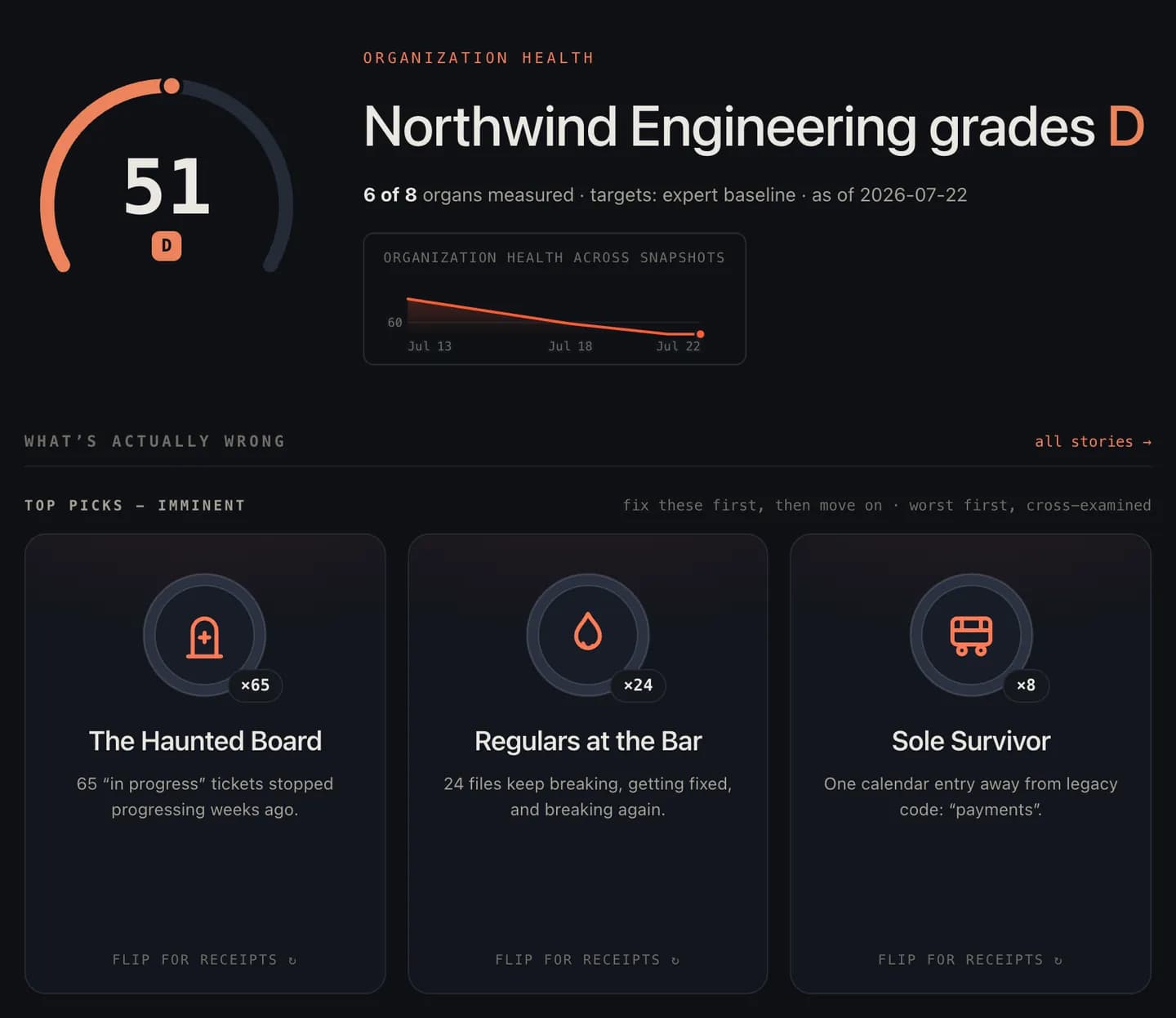
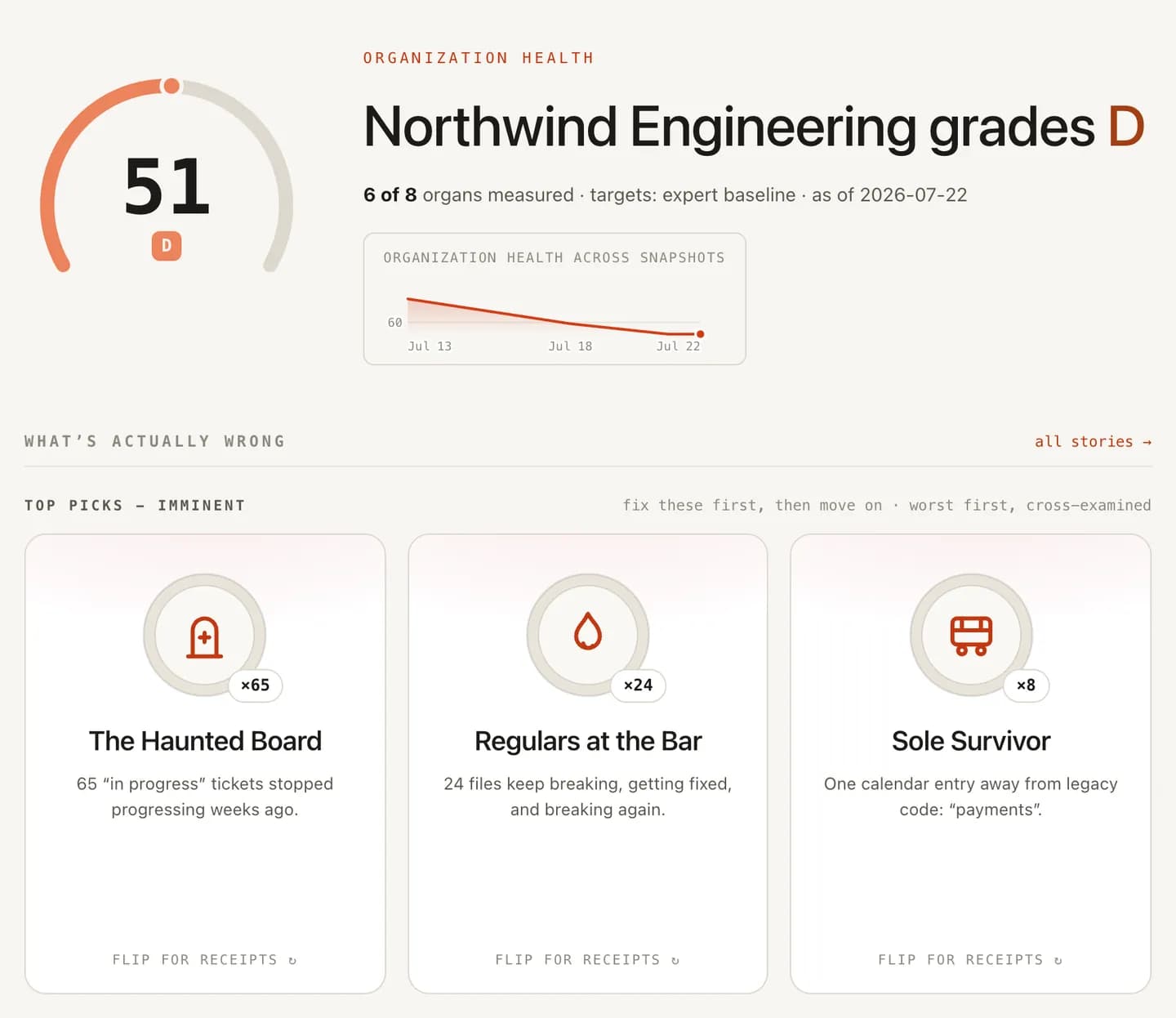
Engineering intelligence vs. developer analytics vs. DORA dashboards
Three overlapping terms, usefully distinguished:
- A DORA dashboard computes the four delivery keys (deployment frequency, lead time, change failure rate, recovery time) and stops. Valuable, narrow, increasingly a commodity. Our DORA explainer covers the metrics themselves.
- Developer analytics historically skewed toward individual activity: commit counts, lines of code, "coding days." This lane produced most of the category's deserved bad reputation, because activity is not outcome and the SPACE research says plainly that no single metric or dimension can represent productivity.
- Engineering intelligence is the widest scope: delivery metrics plus the structural analysis a dashboard can't do - knowledge concentration and bus factor, review-load distribution, AI-impact measurement, cost translation - connected across sources and pointed at decisions.
The category boundaries are marketing-soft, so classify by behavior rather than label: does the tool explain why, does it connect more than one data source, and does it end in a recommendation or just a chart?
What engineering intelligence can tell you
Fair questions the data genuinely answers, each with the receipts to prove it:
- Where delivery time actually goes. Not "we're slow," but which stage eats the days (coding, review pickup, rework, deploy), per team and per repo. The delivery-metrics guide maps this territory.
- Who is a single point of failure. Which areas of the codebase have one meaningful owner, and what stalls the week they leave.
- Whether review is a safety net or theater. Pickup times, review depth, load concentration, and the PRs that merged with nobody really looking.
- What AI adoption is doing. Trends in churn, duplication, and rework as AI-assisted code lands, measured from the history rather than the vendor deck.
- What the friction costs. Queues and silos translated into payroll terms an executive can compare against the price of fixing them.
What it can never tell you
This is the honesty section, and it's load-bearing. The data does not contain:
- Individual worth. The SPACE framework requires multiple dimensions including at least one perceptual measure precisely because system telemetry alone cannot represent a person's contribution. Glue work, mentoring, the bug that never shipped because someone asked the right question in a design review - invisible in git, decisive in reality.
- Why the humans are unhappy. Telemetry shows a review sat for 26 hours; only a human can say whether that blocked someone for a day or nobody cared. Perception data and team-health measurement are complements here.
- What to value. A tool can show you the trade-offs; choosing between shipping speed and platform investment is a leadership call no query returns.
Any vendor claiming otherwise is selling you the astrology tier.
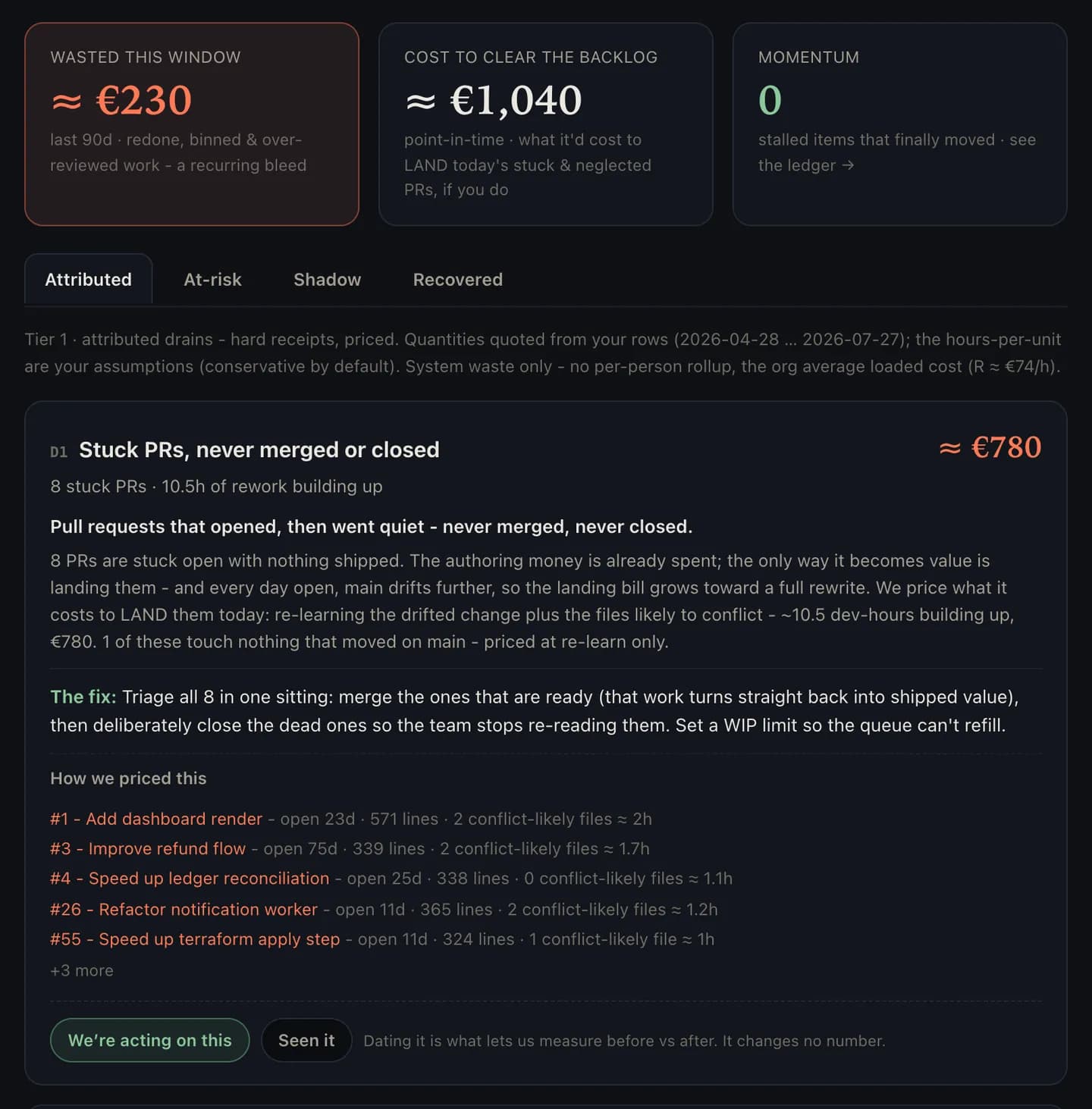
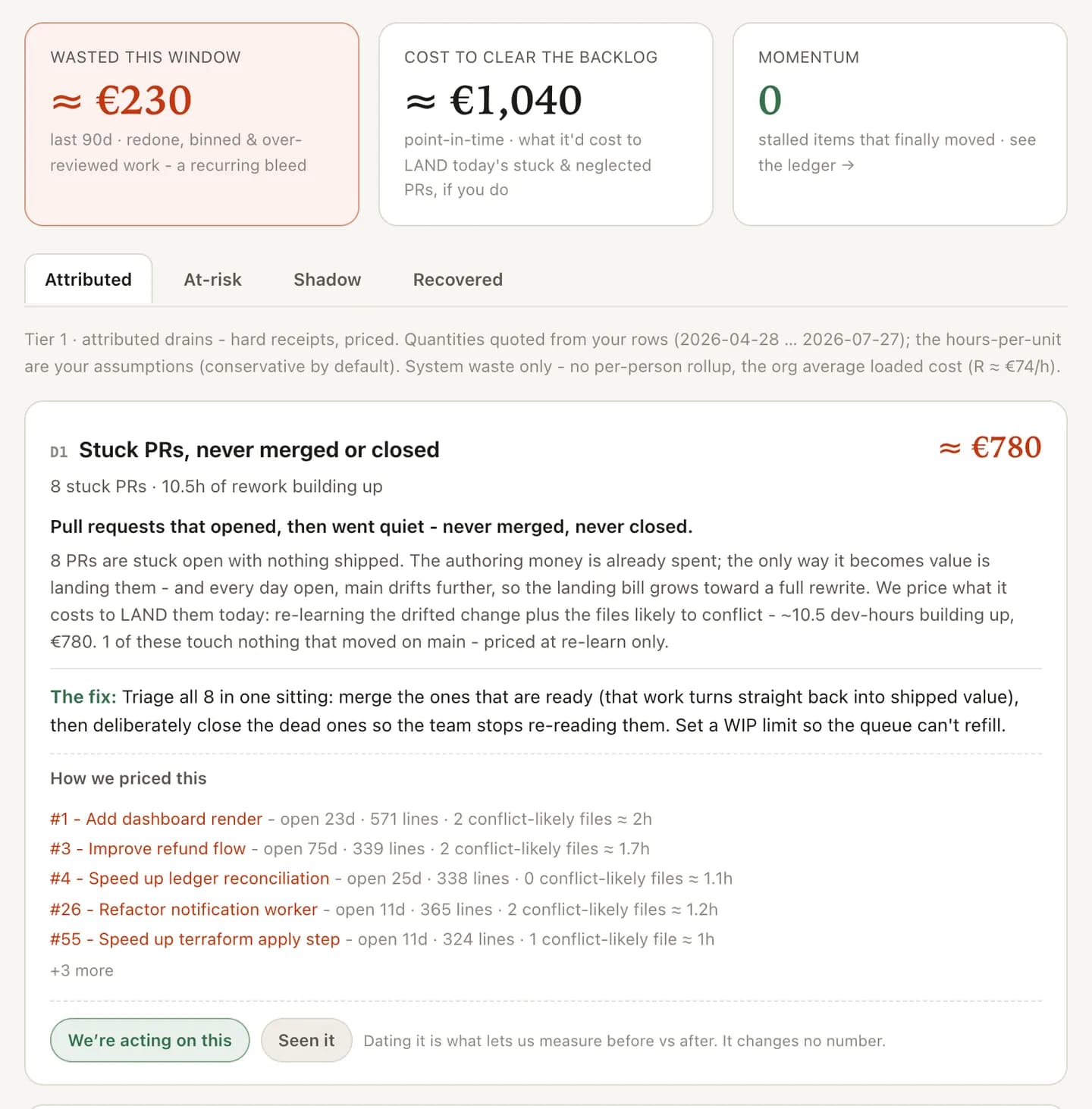
Do you need an engineering intelligence platform?
Maybe not yet, and a category explainer that can't say that is an advertisement. If your whole team fits in one room and your questions still fit in one conversation, spend nothing and read the buyer's guide again when they don't.
The signal that it's time: leadership questions that recur monthly and get answered with anecdotes each time. When "how long do changes take?", "who knows this system?", and "is the AI spend working?" keep coming back without data attached, the diary is worth reading professionally. Start with the evaluation questions before any demo, and if your team leans DIY, run the honest build-vs-buy math first.
The one-line summary of the whole category: your org already wrote down the truth. Engineering intelligence is just the decision to read it - receipts, warts, and all.
Frequently asked
What does engineering intelligence mean?
It's the practice - and the product category - of turning the data your engineering org already generates (commits, pull requests, tickets, CI runs) into decision-grade answers about delivery speed, knowledge risk, review health, AI impact, and cost. Think business intelligence, but pointed at how software actually gets built.
What is the difference between engineering intelligence and DORA metrics?
DORA's four keys are metrics - deployment frequency, lead time, change failure rate, and recovery time. Engineering intelligence is the broader system that computes metrics like these, connects them across data sources, explains why they look the way they do, and points at what to fix. DORA tells you the score; engineering intelligence is supposed to tell you why you're losing.
Is engineering intelligence just developer surveillance?
It shouldn't be, and when it is, it fails on its own terms - surveilled developers game the metrics and the data rots. Honest engineering intelligence measures the system (queues, silos, processes) rather than the person, keeps individual data in coaching context, and never produces a ranked leaderboard of humans.