Busfactor vs Cortex (2026): IDP or Engineering Verdict?
IDP OR ENGINEERING VERDICT
Hover or focus to flip ↻An honest Cortex alternative take: their service catalog and scorecards conceded, why an IDP is not an SEI, and when a platform team should run both.
TL;DR: This is not a head-to-head, and pretending it is would be dishonest. Cortex is an internal developer portal: a service catalog with scorecards, golden paths, and an enterprise sales motion, plus a DORA dashboard on the side. Busfactor is an engineering-intelligence product: an opinionated, evidence-linked verdict on your org's delivery, review flow, knowledge risk, and money drains. If your platform team needs a catalog and standards machinery, Cortex is a credible pick and we'll say so plainly. If your CTO needs a diagnosis nobody had to configure, that's us. Many orgs legitimately want both.
If you searched for a Cortex alternative and landed here, the first useful thing we can do is sort out the category. Cortex sells itself as "Mission Control for the AI Software Factory." Its tagline reads "Code is no longer the bottleneck. Everything else is," and we'd happily sign that sentence. But the product under the tagline is an IDP: a catalog of your services, scorecards measuring them against standards, and self-service scaffolding. The overlap with software engineering intelligence is one module and a shared vocabulary. Everything below is a July 2026 snapshot with claims linked to live sources; verify before you buy, because vendor pages drift.
Before sorting categories, ground yourself in the delivery metrics that actually matter; both kinds of tool ultimately serve them.
What Cortex genuinely does well
The service catalog and context graph. Cortex's core is a live inventory of your services, owners, and dependencies - the thing every organization past a certain size discovers it desperately needs the day an incident pages a team that dissolved two reorgs ago. Busfactor does not do this and isn't going to: catalog CRUD, ownership records, and dependency graphs are a real product that deserves a real vendor.
Scorecards with standards machinery. Cortex ships templated scorecards (Production Readiness, Service Maturity, DORA, AI Readiness), scored per service with gamified levels, so a platform team can define "what good looks like" and drive adoption service by service. This is genuinely effective org-change tooling: the score creates the conversation, the levels create the ladder.
Golden paths for humans and agents. Self-service scaffolding, the "spin up a new service the approved way" flow, now extended to AI agents, with MCP support and a proprietary DRIVE framework covering sustainable speed, runaway-risk, and human oversight. As AI agents start opening PRs, "paved roads that agents also follow" is a real platform concern, and Cortex is early to it.
Enterprise posture. SOC 2 Type 2 and ISO/IEC 27001:2022 certified, with vendor-published customer results (a 75% MTTR reduction at H&R Block is the headline claim; vendor-published and unaudited, so weigh accordingly). Busfactor doesn't hold those certifications today. If procurement requires them now, that's a real gap on our side.
The category line: standards you author vs a verdict you don't
Here's the distinction that should actually drive your decision.
Cortex measures your services against standards you define. A scorecard is an empty instrument until your platform team decides what a Gold service looks like, which checks matter, and what the thresholds are. That's by design: it's standards-adoption machinery, and its output is "service X is at Silver, here's the gap to Gold." The Engineering Intelligence module adds a DORA dashboard mapped to team activity, but a DORA dashboard is a chart, and a chart is not an opinion.
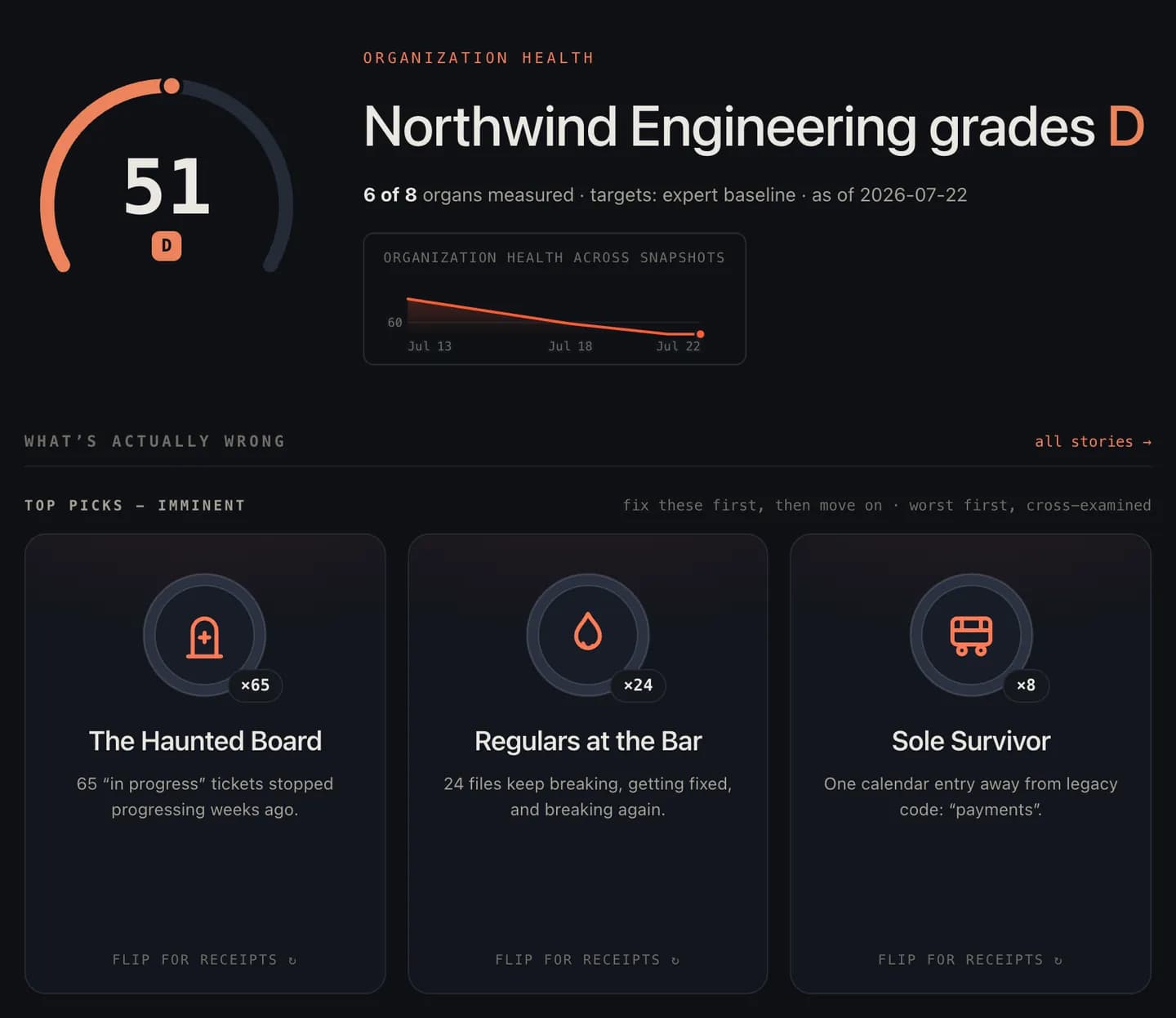
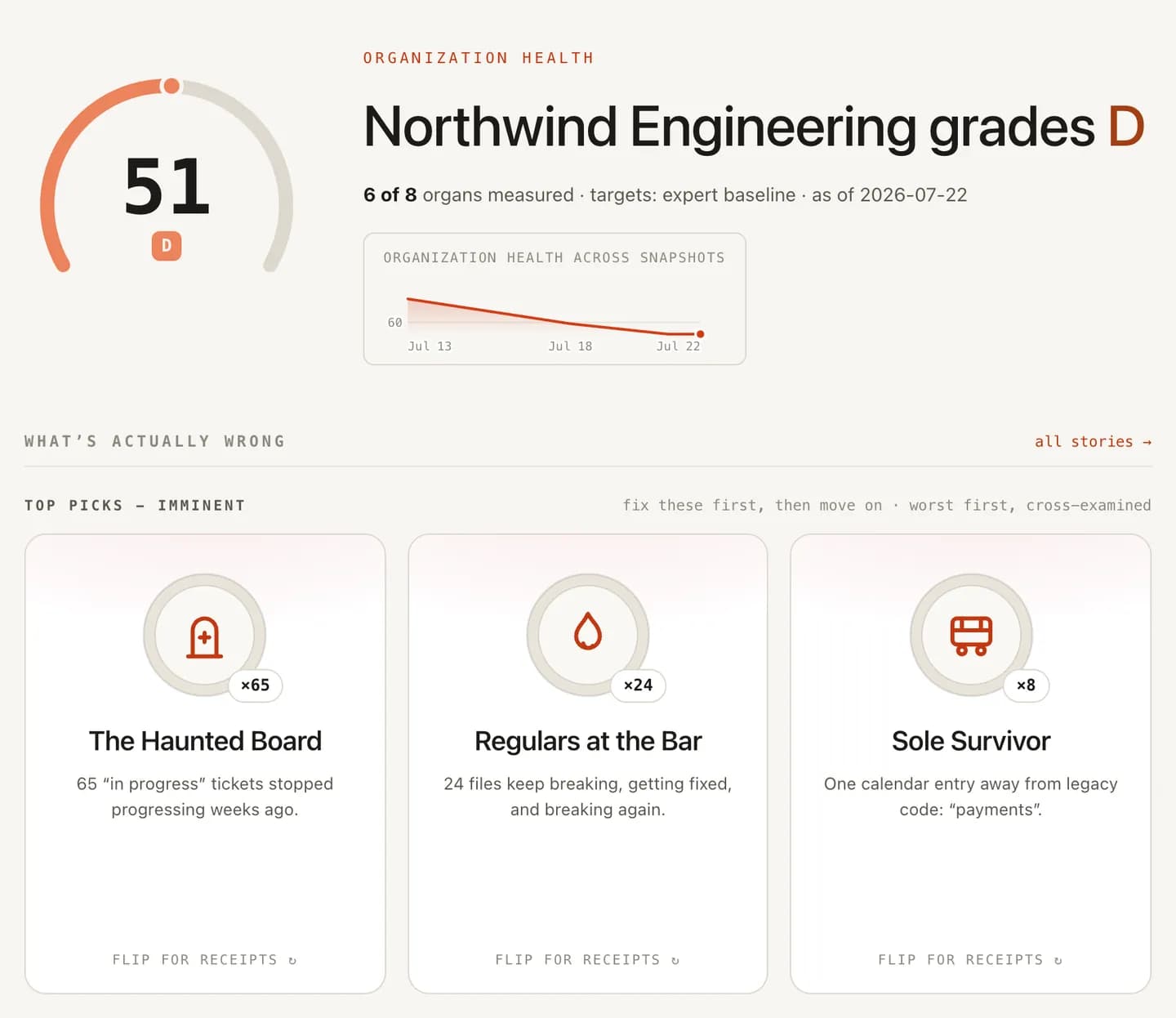
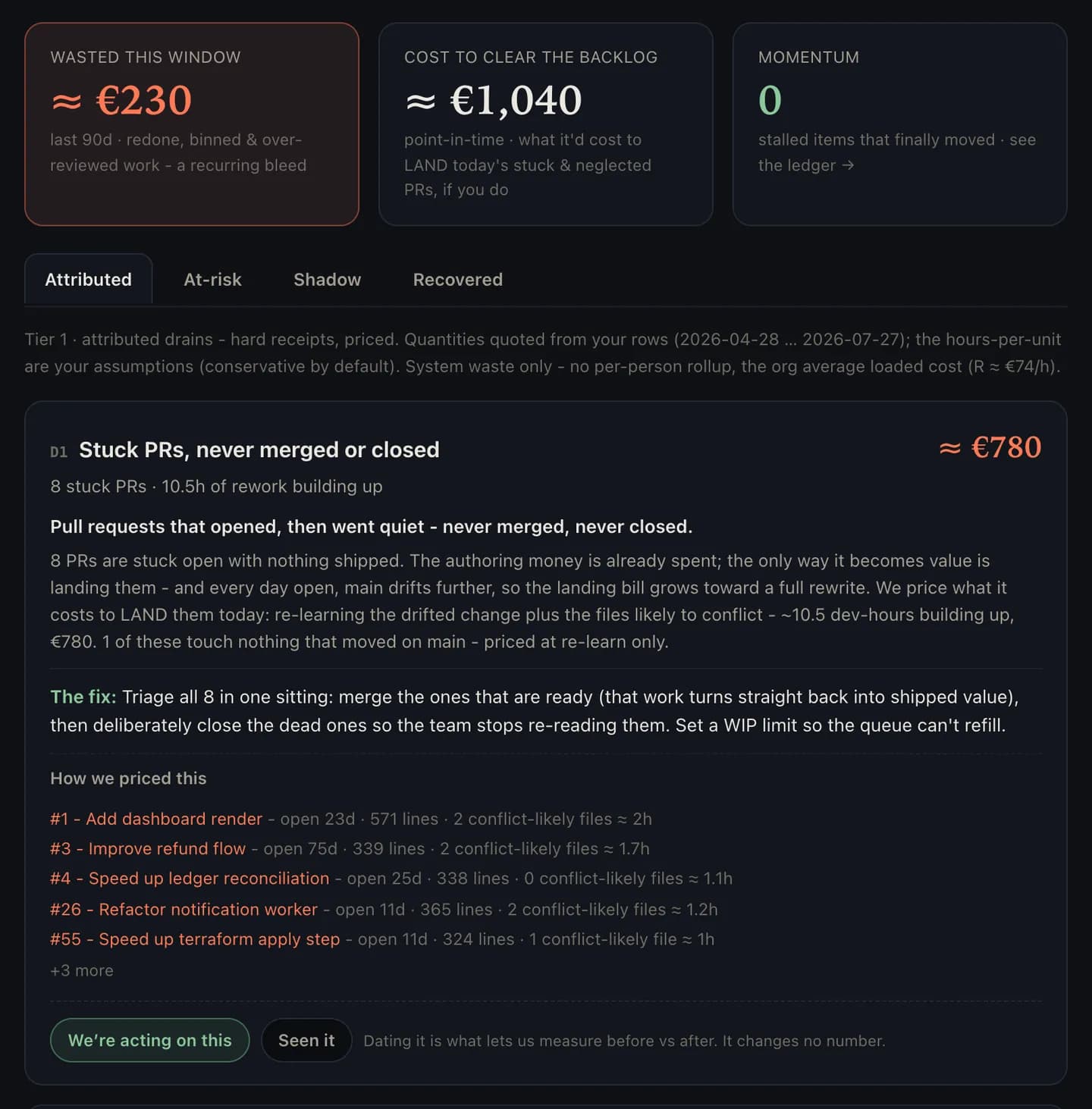
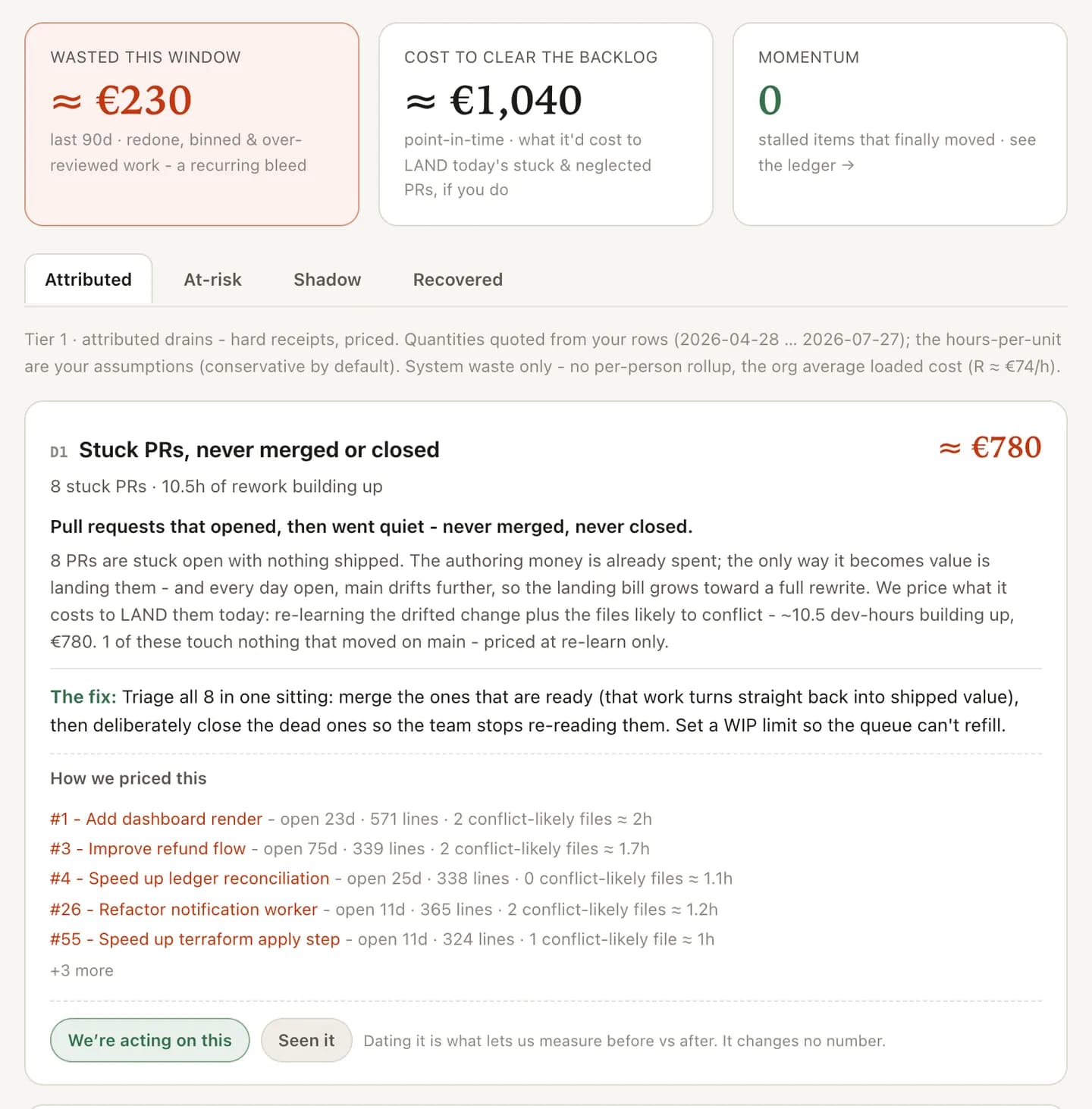
Busfactor delivers the opinion. No standards authoring, no scorecard configuration: connect the org and the assessment judges dozens of stats against published, cited bands - good, bad, fix-this - with the receipts (actual PRs, commits, tickets) linked on every claim. Drains get priced in your currency on the money surfaces, fixes carry payback estimates, and the quarter gets a letter grade in the report card. The buyer is different too: a Cortex rollout is a platform-team project measured in quarters; a Busfactor read is a CTO decision measured in an afternoon.
The vocabulary convergence is real; both products now say "AI readiness." The mechanics split along the same line: Cortex's AI Readiness scorecard checks services against criteria you configure; our AI read is judged from repository evidence with deterministic AI attribution and disclosed blind spots. (What an honest readiness assessment looks like is in the AI coding readiness checklist.)
Pricing: a quote motion vs published tiers
As of July 2026, Cortex's pricing page publishes no prices. It's a demo-and-quote enterprise motion. Third-party estimates have put enterprise contracts in the six figures annually; those are not Cortex's numbers, so treat them as unverified rumor and get your own quote. Busfactor's per-developer tiers are published on the pricing page, self-serve, with every capability in every paid tier. That asymmetry isn't a gotcha. It reflects the buyers: platform-wide IDP deals get negotiated; a diagnosis subscription gets swiped. (If self-serve IDP pricing matters to you, Port publishes theirs, free tier included, and that comparison covers the same category line from the other side.)
Who should pick which
| You are… | Pick |
|---|---|
| A platform team that needs a service catalog, ownership records, golden paths | Cortex |
| Driving standards adoption across hundreds of services, want gamified levels | Cortex |
| Need SOC 2 / ISO-certified vendors on the checklist today | Cortex |
| A CTO who wants a judged diagnosis with receipts, not standards to author | Busfactor |
| Need drains and fixes priced in your currency, re-runnable byte-identically | Busfactor |
| Worried about knowledge risk and review flow, not service maturity ladders | Busfactor |
| A larger org with both a platform team and a CTO who wants straight answers | Honestly: both |
If what you actually wanted was an SEI-versus-SEI comparison, our buyer's guide maps that category properly, and the evaluation questions work on any vendor - including us, and including an IDP's EI module. And if your confusion came from the workflow side rather than the portal side, Graphite and Aviator get the same honest category-clarification treatment.
Frequently asked
Is Cortex an engineering intelligence (SEI) tool?
Not primarily. Cortex is an internal developer portal (IDP): a service catalog with a context graph, scorecards that measure services against standards you define, and golden-path scaffolding for developers and AI agents. It does ship an Engineering Intelligence module with a DORA dashboard mapped to team activity, which is where the category confusion comes from. But the core job is cataloging and standardizing services, not diagnosing the org. If you're evaluating Cortex against SEI tools like LinearB, Jellyfish, or Busfactor, you're comparing across categories.
How much does Cortex cost?
Cortex publishes no pricing as of July 2026; it's a demo-and-quote enterprise motion. Third-party estimates (not Cortex's own numbers, so treat them as unverified) have placed enterprise contracts in the six-figure-per-year range. Busfactor publishes per-developer tiers on its pricing page. The two aren't really price-comparable because they aren't job-comparable: one is a platform-team purchase, the other a CTO diagnosis.
Can we use both Cortex and Busfactor?
Yes, and for larger orgs that's often the honest answer. Cortex gives your platform team a catalog, ownership records, and scorecards to drive standards adoption service by service. Busfactor gives your CTO a judged, receipts-linked diagnosis of the whole org - delivery, review flow, knowledge risk, money drains - without anyone having to author the standards first. Different buyers, different jobs, no data conflict.