Busfactor vs Graphite (2026): Ship Faster, Then Ask Why
THEN ASK WHY
An honest Graphite alternative view: stacked PRs, merge queue, and AI reviews act on your code; we diagnose the system behind it. Different jobs, cited.
The band we grade against.
Illustrative example
TL;DR: Graphite and Busfactor are not competitors, and any comparison page that pretends otherwise is selling you something. Graphite is an act-layer: stacked PRs, a stack-aware merge queue, and an AI reviewer that literally writes comments and merges code. Busfactor is an intelligence layer: a judged, receipts-linked diagnosis of your delivery system with the drains priced. The confusion comes from Graphite's Insights dashboard, which overlaps SEI vocabulary without doing the SEI job. Concessions here are total: if you want stacked PRs and merge automation, buy Graphite. Then measure whether it worked with something that has no stake in the answer.
Graphite built its product around a strong opinion: PRs should be small, stacked, and merged by machinery. The stacked-PR CLI manages dependent chains with auto-rebase; the merge queue batches and lands stacks; Graphite Agent - their AI reviewer - proposes inline fixes and can update or merge PRs from chat. It's a bottom-up, PLG tool that spread through AI-heavy, high-velocity shops for a simple reason: it does something to your workflow, every day. Busfactor does nothing to your workflow. We read it, judge it, and price what's wrong. Different jobs. Everything below is a July 2026 snapshot with sources linked; prices drift, so re-verify.
Both categories ultimately answer to the same fundamentals, the delivery metrics that actually matter, so start there if you haven't.
What Graphite genuinely does well
Stacked PRs as a discipline. Dependent-change chains with automatic restacking turn "one giant PR or three blocked ones" into a smooth pipeline of small reviewable units. Small PRs are one of the most defensible wins in the entire delivery literature (our own PR-size piece makes the same case from the diagnosis side), and Graphite operationalizes the habit instead of lecturing about it.
The merge queue. Stack-aware batching that keeps a busy trunk green without humans babysitting merge order. At high merge volume this is infrastructure, not convenience.
Their AI reviewer also gets adopted, which is rarer than it sounds. Graphite Agent reviews with inline suggested fixes, plus a chat surface that can update and merge PRs, with MCP support down to the free tier. Whatever one thinks about AI review quality in 2026, distribution-wise they've made it frictionless.
To be unambiguous: Busfactor ships none of this and won't. We deliberately do not act on your PRs - no automation, no review bot, no queue. Observe and prescribe is the whole posture.
The category line: the dashboard is not the product
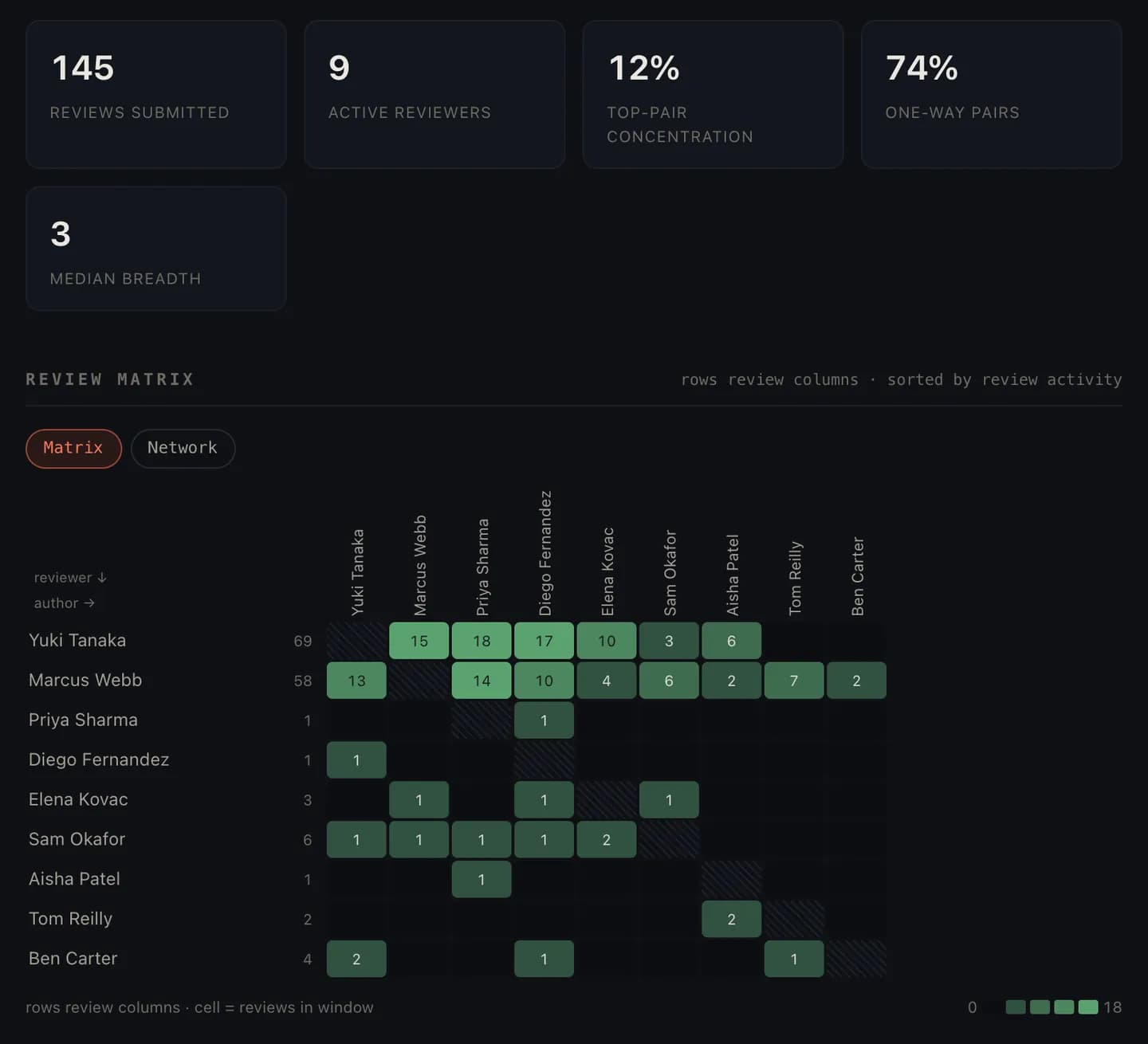
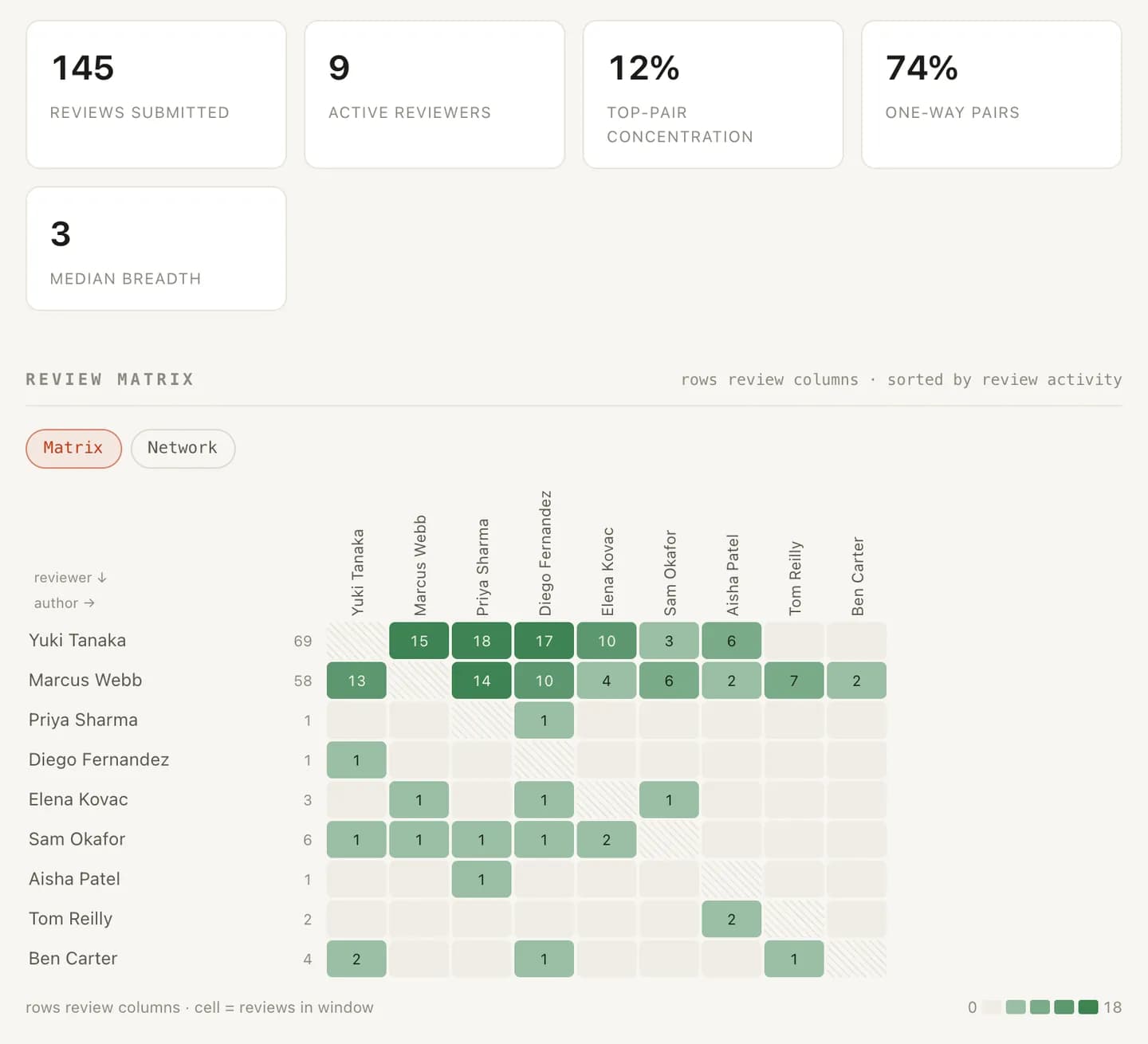
Graphite's Starter tier includes "team insights" and the Enterprise tier "custom analytics": velocity, review workload distribution, PR cycle times. This is the overlap that lands Graphite on SEI shortlists, and here's the honest read: those dashboards exist to show that Graphite is working. They're a by-product of the workflow product - useful, narrow, and structurally uninterested in anything Graphite can't fix.
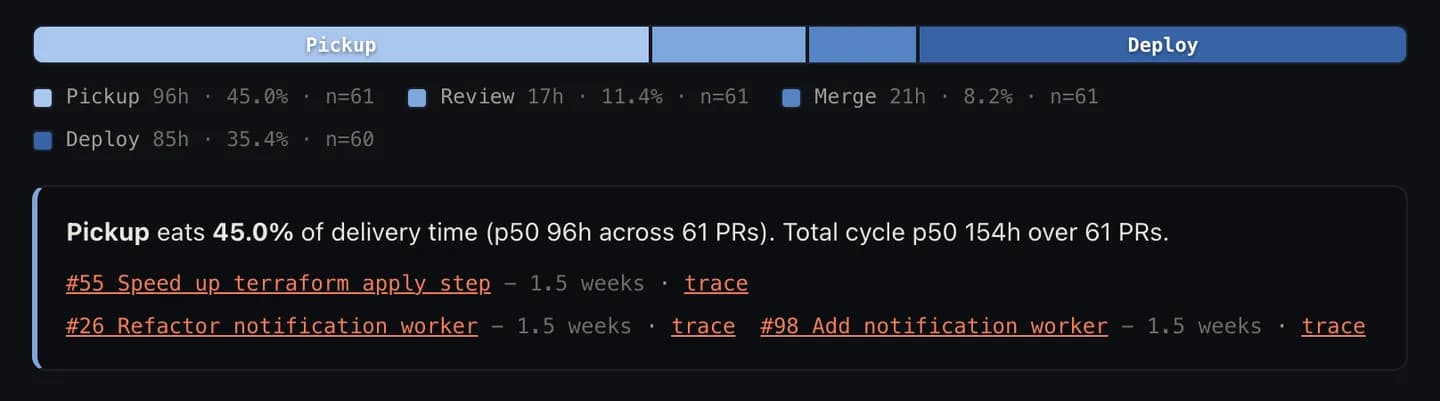
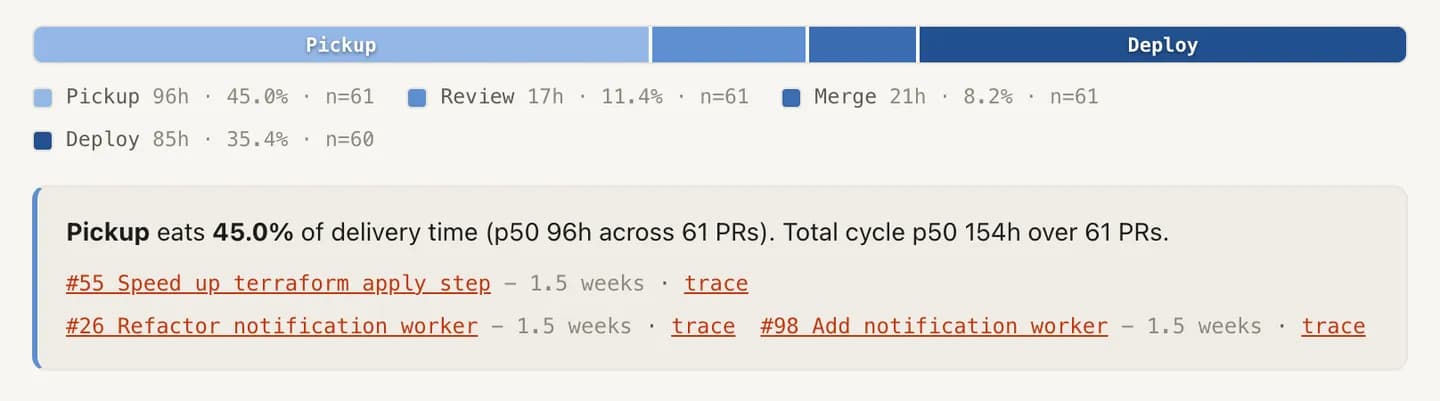
A diagnosis has a different scope and a different loyalty. Busfactor's assessment judges your delivery system against published bands: review flow and pickup-time pathologies, knowledge concentration and bus-factor risk, dead work, ticket loops. Receipts are linked on every claim, drains priced in your currency on the money surfaces, and each quarter gets a graded report card. None of that is a merge queue's job, and a merge queue's dashboard will never tell you your review load sits on two people who are also your top flight risks.
There's also a clean data relationship instead of a rivalry: AI reviewers are a source for us. Busfactor's AI metrics count AI-reviewed share from review-bot activity deterministically. Graphite Agent's reviews show up in that number exactly like any other AI reviewer's. And the before/after question every Graphite buyer should ask - did pickup time, PR size, and throughput actually move after rollout? - is precisely the kind of question you want answered by a vendor with no stake in the tool's success.
Pricing, side by side
As of July 2026, from Graphite's pricing page: Hobby free (personal repos, stacked-PR CLI, MCP, limited AI reviews); Starter $20/user/month billed annually (org repos, Slack notifications, team insights); Team $40/user/month (unlimited AI reviews, Graphite Chat, automations, basic merge queue); Enterprise custom (advanced merge queue, custom analytics, SAML/SSO, ACLs, SIEM audit logs, GitHub Enterprise Server). Busfactor's per-developer tiers are on the pricing page. Both are per-seat, so the comparison is a straight rate check, but since the products aren't substitutes, the real budgeting question is which line item you're funding: dev-tooling (theirs) or engineering leadership intelligence (a different one).
Who should pick which
| You are… | Pick |
|---|---|
| A team drowning in big PRs and merge conflicts, wants workflow change now | Graphite |
| High merge volume on a busy trunk, needs a queue that keeps it green | Graphite |
| Wants an AI reviewer wired into the daily PR loop | Graphite |
| A CTO who needs to know where delivery actually leaks, with receipts | Busfactor |
| Wants drains priced and fixes ranked by payback, re-runnable byte-identically | Busfactor |
| Rolling out Graphite and wants an unbiased before/after measurement | Busfactor (alongside) |
| Honestly asking "do we need both?" | Quite possibly - different jobs |
If a merge queue at monorepo scale is the actual requirement, also read the Aviator comparison: same category clarification, deeper queue machinery. If your confusion came from the platform side instead, the Cortex and Port pages draw the IDP line. And for the tools that actually are in our category, the buyer's guide plus the evaluation questions are the fair fight.
Frequently asked
Is Graphite an engineering analytics tool?
No; it's a PR-workflow tool. Graphite's product is stacked pull requests (dependent chains with auto-rebase), a stack-aware merge queue, and Graphite Agent, an AI reviewer that proposes inline fixes and can update or merge PRs via chat. It does include an Insights dashboard (velocity, review workload distribution, PR cycle times), which is why it shows up on analytics shortlists, but the dashboard is a by-product of the workflow product, not a diagnosis. If you're comparing Graphite to SEI tools, you're comparing a tool that acts on PRs to tools that analyze them.
How much does Graphite cost?
As of July 2026, Graphite's published pricing: Hobby free (personal repos, the stacked-PR CLI, MCP support, limited AI reviews); Starter at $20/user/month billed annually (org repos, Slack notifications, team insights); Team at $40/user/month (unlimited AI reviews plus Graphite Chat, automations, basic merge queue); Enterprise custom (advanced merge queue, custom analytics, SAML/SSO, ACLs, SIEM audit logs, GitHub Enterprise Server support). Busfactor's per-developer tiers are published on its pricing page, but the two aren't substitutes, so you'd rarely be choosing between them on price.
Does Busfactor replace Graphite, or the other way around?
Neither. Graphite changes how your PRs move: smaller stacked changes, automated merges, AI review comments. Busfactor tells you what your whole delivery system is doing and what it costs: where work waits, who reviews what, where knowledge concentrates, which drains are worth fixing first. One acts, one diagnoses. Teams that adopt a workflow tool arguably need the diagnosis more, because you want an honest before/after read on whether the new workflow actually moved pickup time, review load, or throughput, measured by a party with no stake in the answer.