LinearB vs Faros AI (2026): Benchmarks or the Big Schema
BENCHMARKS OR THE BIG SCHEMA
LinearB vs Faros AI in a cited 2026 head-to-head: the benchmark cohort against the canonical schema, pricing floors, and what neither lets you re-run.
The band we grade against.
Illustrative example
TL;DR: LinearB and Faros AI are both telemetry-first engineering-intelligence platforms and 2026 Gartner-recognized names, but they're built for different altitudes. LinearB is the mid-market SEI you can start using this week: published pricing, a 45-day trial, live benchmarks from 8.1M+ PRs, and gitStream automation that acts on your PRs. Faros AI is the enterprise data estate: 100+ tools normalized into one canonical schema, A/B cohort methodology, on-prem deployment, and a GenAI insight layer, all at quote-only prices. Both put probabilistic machinery in load-bearing places, and neither claims a re-runnable number. That gap is where this page ends up.
This page is written by a third vendor, Busfactor, which is precisely why it can afford to be fair: we win nothing by misrepresenting either product. Everything is cited to vendor material as of July 2026; pricing pages drift, so re-verify before a business case.
Two altitudes, one category
LinearB is the volume leader of mid-market SEI: 3,000+ companies by its own claim, a Leader in the inaugural 2026 Gartner MQ for Developer Productivity Insight Platforms. The pitch: DORA and delivery metrics out of the box, the category's largest published benchmark cohort (8.1M+ PRs from 4,800 teams across 42 countries, banded Elite/Good/Fair/Needs Focus across 20 metrics), and gitStream, programmable PR automation that routes reviews to code experts, labels estimated review time, and auto-approves low-risk changes.
Faros AI is engineering intelligence as a data platform, aimed at orgs with hundreds to thousands of engineers and dozens of tools. Its moat is the canonical layer: everything - git, Jira, Azure DevOps, CI/CD, incident tools, "data from over 100 tools" - normalized into one schema, with cross-tool attribution mapping work to teams and services, custom dashboards on top, and SaaS, hybrid, or on-prem deployment. In 2026 it added Clara, a context product that feeds coding agents and generates PRs. Faros is crossing from measuring the SDLC to acting in it.
Different altitudes, honestly: a 40-developer org has no use for a canonical schema across 30 tools, and a 2,000-developer org will outgrow dashboard-first SEI. The comparison is live in the overlap of roughly 100 to 500 engineers, where both vendors actively sell.
Where LinearB wins
Speed to value and price you can read. Published pricing (Essentials $29/contributor/month, minimum 30 users; Enterprise $59, minimum 50) and a 45-day full-platform trial with no card. Faros has no self-serve motion at all.
The benchmark cohort. In-product comparison against 8.1M+ PRs is a first-meeting hook no enterprise data platform matches. Faros offers industry benchmarks too, but LinearB's published cohort scale is the category's largest.
Automation that acts. gitStream changes PR workflows the day it's configured. Faros' Clara generates PRs for agents, a different and newer bet, but LinearB's PR-workflow automation is mature and widely deployed.
Where Faros AI wins
Breadth and depth of the estate. 100+ tool integrations, any-source ingestion, one canonical schema, warehouse-grade custom analytics, incident-tool coverage, on-prem. At enterprise scale this is a different weight class than dashboard-first SEI. LinearB's non-GitHub git providers and issue-tracker integration sit in its Enterprise tier; Faros treats heterogeneous estates as the default customer.
Evaluation methodology. The Copilot module runs A/B and before/after cohort comparisons with seniority segmentation, which is closer to real program evaluation than adoption dashboards. And its research arm published the Acceleration Whiplash report: 22,000 developers, 4,000 teams, two years of telemetry - the best public dataset on what heavy AI adoption does to a delivery system.
The finance-adjacent surfaces. Token intelligence (AI spend traced toward outcomes), allocation, and R&D capitalization are platform citizens rather than add-ons.
Where both are exposed
Probabilistic machinery in load-bearing places. LinearB's AI Analytics classifies work as AI-assisted via a confidence threshold. Per their own release notes, the default launched at 50, became configurable in March 2026, and was cut to 25 in June 2026. Same history, different knob position, different adoption story, and every chart drawn under the old default quietly changed meaning mid-year. On the Faros side, how "% of AI-generated code" is computed is not disclosed on the public pages, and Lighthouse AI puts GenAI summaries directly in the interpretation loop. The layer that can misstate a number is the layer that narrates all of them.
No reproducibility claim. Neither vendor's public material offers the test that settles arguments with a CFO or an auditor: re-run a past period, diff the output. Both are honest companies; the architecture just doesn't make that promise.
Nobody grades the org. Both hand you dashboards, benchmarks, and (increasingly) AI narration. Neither issues a verdict, prices a drain, or puts a payback period on a fix.
The diagnosis layer neither ships
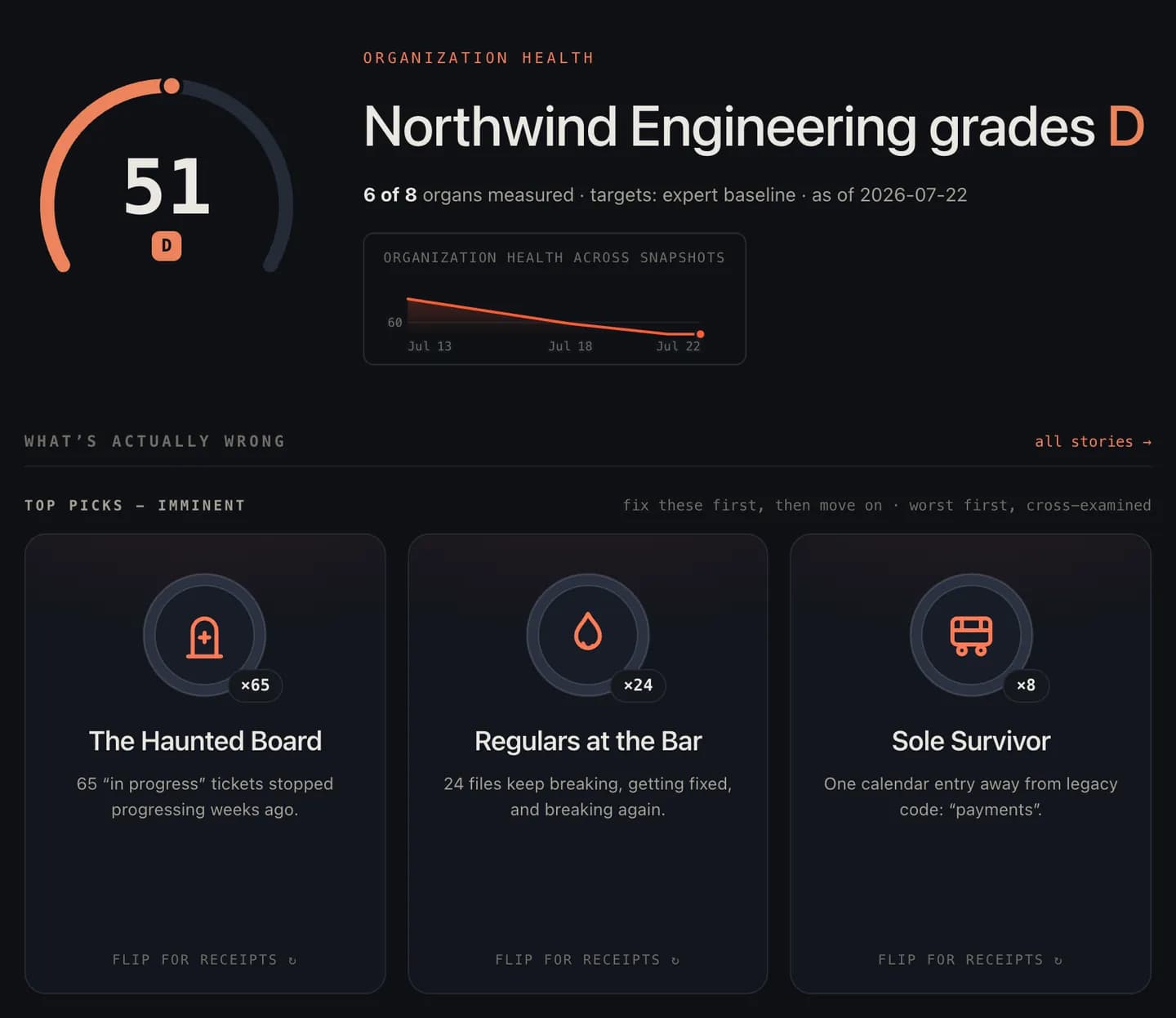
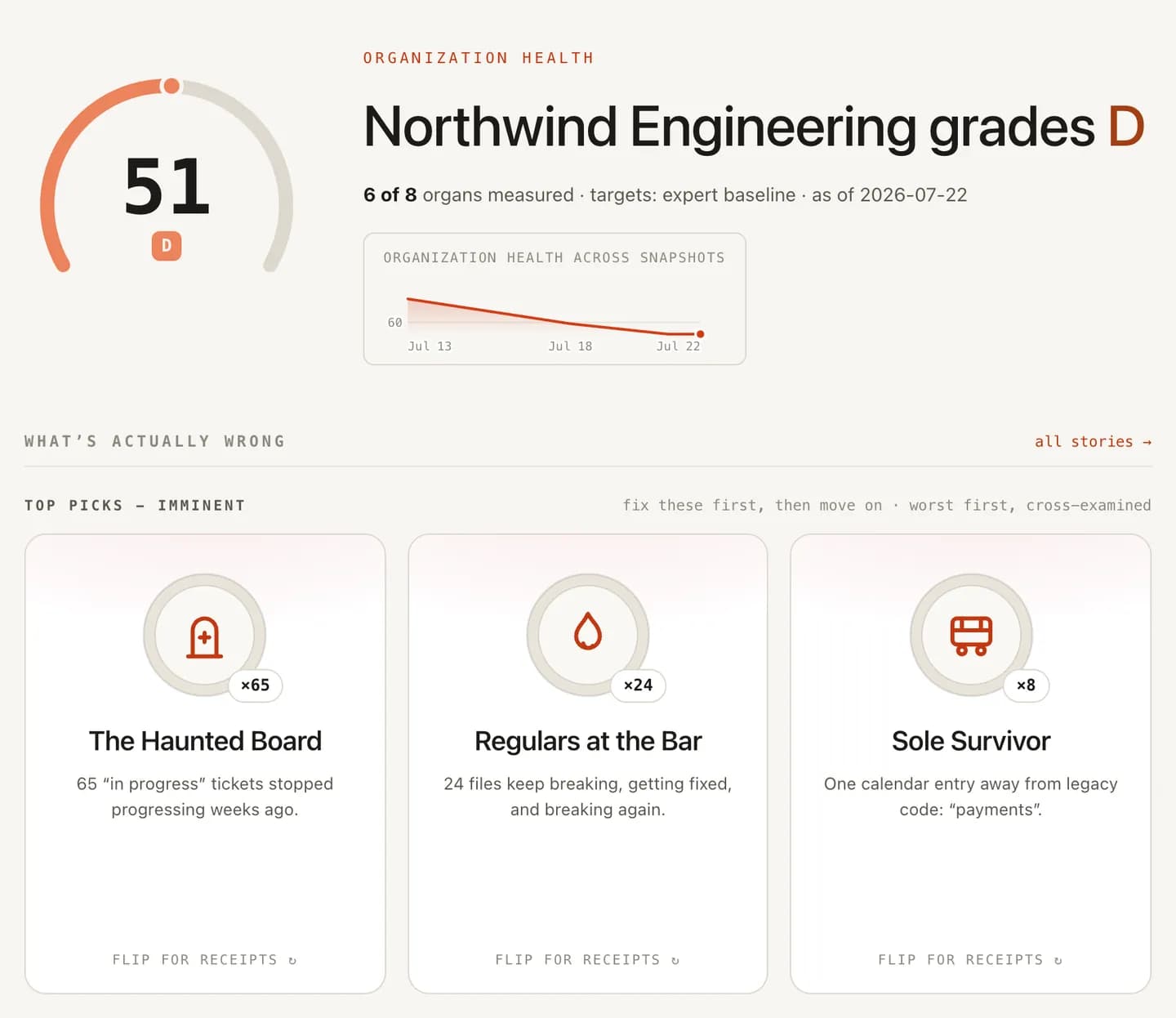
Here's the irony: Faros' own Whiplash data - at high AI adoption, bugs per developer +54%, median review time 5x, 31% more PRs merged without review - is the best public argument that what an engineering org needs in 2026 is not more dashboards but a diagnosis of whether acceleration is breaking its system. That diagnosis layer is what Busfactor is. Metrics judged against published bands with receipts linked on every claim (assessment). Drains and consequences priced in your currency with payback estimates (money). Zero LLM in the metric path, and byte-identical re-runs with provenance printed on exports, the test neither platform above claims. Flat published pricing, self-serve, under both vendors' effective floors.
Direct head-to-heads, concessions first, are here: Busfactor vs LinearB and Busfactor vs Faros.
LinearB vs Faros: the decision table
| You are… | Pick |
|---|---|
| 50-300 devs, want benchmarks + PR automation, self-serve trial | LinearB |
| Sold on live peer percentiles as the core artifact | LinearB |
| 500+ devs, 30 tools, need one schema + custom analytics + on-prem | Faros AI |
| Evaluating AI programs with real cohort methodology | Faros AI |
| Need re-runnable numbers and a graded, priced diagnosis | Busfactor |
| Under the seat minimums and floors both motions assume | Busfactor |
For the metric fundamentals both platforms measure, start with the metrics that actually predict delivery. Adjacent matchups: GitClear vs LinearB if code quality is the axis, and Jellyfish vs DX if the budget is being pulled by finance or a DevEx program instead.
Frequently asked
What is the main difference between LinearB and Faros AI?
Motion and grain. LinearB is a self-serve-friendly SEI platform: published per-contributor pricing, a 45-day trial, the category's largest published benchmark cohort (8.1M+ PRs from 4,800 teams), and gitStream PR automation. Faros AI is an enterprise data platform: 100+ tool integrations normalized into one canonical schema, custom warehouse-grade analytics, on-prem options, and quote-only pricing. LinearB is the faster start; Faros is the deeper estate.
How much does LinearB cost compared to Faros AI?
As of July 2026, LinearB publishes pricing: Essentials at $29 per contributor per month (annual billing, minimum 30 billable users) and Enterprise at $59 (minimum 50 users), which gates Jira/Azure Boards, Slack/Teams, forecasting, cost capitalization, and non-GitHub providers. Faros AI publishes no prices - three quote-only tiers differing on connector types, SSO/SAML/RBAC, and deployment model, with fees quoted in US dollars. One you can read off the page; the other is a sales conversation.
What does Faros AI's Acceleration Whiplash research actually say?
It's one of the most useful public datasets in the field: 22,000 developers and 4,000 teams over two years of telemetry. At high AI adoption their data shows PR sizes up 51 percent, bugs per developer up 54 percent, median review time five times longer, and 31 percent more PRs merged without review - statistically significant correlations, per their framing, not proven causation. It's the strongest published evidence that AI-accelerated output needs an org-health check reading the same repos.
Receipts
- LinearB - Pricing page (as of July 2026)
- LinearB - Engineering Benchmarks report (8.1M+ PRs, 4,800 teams)
- LinearB - 2026 release notes (AI Analytics threshold changes, MCP)
- gitStream documentation - how it works
- LinearB - 2026 Gartner Magic Quadrant Leader announcement
- LinearB - DORA metrics blog (3,000+ companies claim)
- Faros AI - Platform (canonical schema, 100+ tools)
- Faros AI - Copilot module (AI evaluation methodology)
- Faros AI - Lighthouse AI (GenAI insight layer)
- Faros AI - Pricing (quote-only tiers, as of July 2026)
- Faros AI - The Acceleration Whiplash research report (2026)
- Faros AI - Clara (agent context, generated PRs)